
Tuesday, 25 August 2026
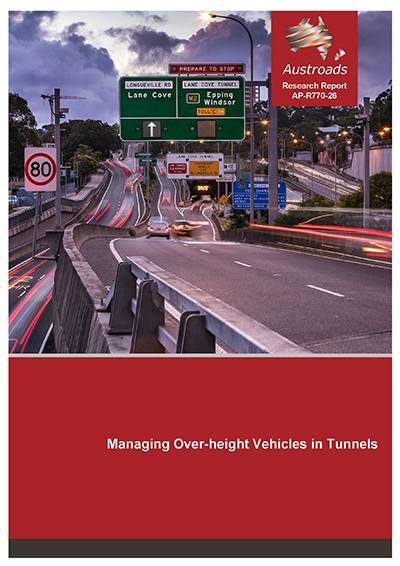
Preventing an over-height vehicle from entering a tunnel is far more effective than managing the consequences after it does. Austroads has identified opportunities to strengthen the management of over-height vehicles approaching tunnels, helping road agencies and tunnel operators intervene earlier and minimise disruption to tunnel operations.
Over-height vehicle incidents continue to present operational, safety and asset protection risks across Australia and New Zealand. While most managed tunnels meet the requirements of the Austroads Guide to Road Tunnels and operators generally report confidence in their procedures, incidents continue to occur, highlighting the importance of early intervention and coordinated operational responses.
The research examined how over-height vehicles are managed once they are already on the road network and at risk of entering a tunnel. Drawing on Australian, New Zealand and international practice, the study assessed approaches across the prevention, mitigation, response and recovery stages of the incident lifecycle.
A key finding was that the most effective opportunity to influence outcomes occurs before a vehicle reaches a tunnel portal.
Clear warnings, sufficient time for drivers to recognise restrictions and divert, and timely detection and verification by operators were found to significantly reduce the likelihood of a vehicle entering a tunnel and triggering network disruption.
“Once an over-height vehicle passes the final diversion point, the number of available response options reduces considerably. Providing drivers and operators with enough time and information to act before a vehicle reaches the tunnel is key to preventing incidents and avoiding significant network disruption,” said Ross Guppy, Austroads Transport Infrastructure Program Manager.
The review also found that tunnel characteristics have a significant influence on the range of available management options. Many newer tunnels have been designed with contemporary over-height vehicle detection systems, improved pull-over facilities and higher clearances, while older tunnels may face physical constraints that require different approaches.
“Technology plays an important role, but outcomes are ultimately influenced by how well detection systems, roadside infrastructure and operational procedures work together,” said Ross.
Rather than identifying a single solution, the research found that successful management depends on combining technology, infrastructure, operational procedures and clear decision-making processes in a way that reflects local conditions. This includes considering the geometry of the tunnel approach, traffic conditions, operational arrangements and the tunnel’s risk profile.
The recommendations encourage a stronger focus on system integration, operational coordination and performance-based outcomes. They also highlight the importance of tailoring treatments to individual tunnels, recognising that measures that work effectively in one location may not be appropriate in another.
Download Managing Over-height Vehicles in Tunnels.
Join the webinar
Thursday, 5 November 2026 at 1:00 PM AEDT | Presented by Chris Adams, Shifani Sood and Tom Betts. The session includes live Q&A.
No charge but registration is essential. Can't make the live session? Register and we'll send you a link to the recording.