
Pavement
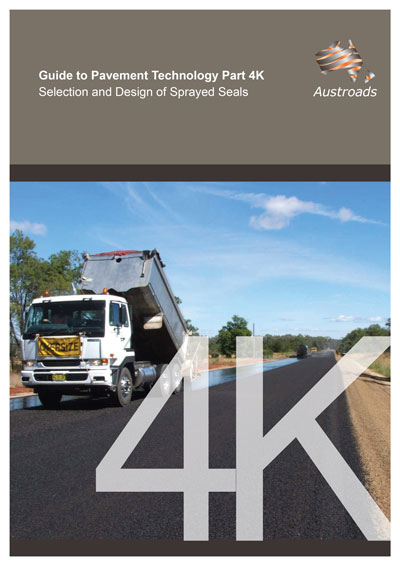
- Publication no: AGPT04K-26
- ISBN: 978-1-923617-34-6
- Published: 27 February 2026
- Edition: 1.4
- PDF (free) Download
Guide to Pavement Technology Part 4K: Selection and Design of Sprayed Seals is a guide to the procedures for the selection and design of sprayed seals.
This is an update of previous Austroads procedures based on the philosophy of filling up voids in the aggregate matrix with binder, to a depth of about one half to two thirds the height of the aggregate when laying on its least dimension.
The Guide discusses the historical background and operational environment of sprayed seals, alongside design, selection and construction procedures for various types of sprayed seals.
Research report
The technical basis and the process to update this Guide has been elaborated in the research report Technical Basis for the Update of Austroads Guide to Pavement Technology Part 4K: Selection and Design of Sprayed Seals (AP-T384-26).
Webinar
Watch a recording of the webinar to learn more.
Edition 1.4 published Febraury 2026
Edition 1.4 includes:
- Corrected ‘seal’ definitions (Chapter 3)
- Updated Figures 3.5 and 3.12
- Removed ‘aggregate retention seal’ and ‘foamed bitumen sealing’ references throughout and replaced ‘S45R’ with ‘S15R’
- Added S9R/S9RF binder guidance; recategorised S15E (Tables 4.7, 6.4, 6.5)
- Updated binder recommendation for Geotextile Reinforced Seal as initial seal (Table 4.7) and additional guidance on geotextile binder retention (Section 6.5.1)
- Removed Average Least Dimension (ALD) nomograph calculation option (Section 5.3.1).
Superseded editions:
- Edition 1.3 published in November 2019
- Edition 1.2 published in October 2018
- Edition 1.1 published in September 2018
- Edition 1.0 published in August 2018.
This Guide was previously published as Guide to Pavement Technology Part 4K: Seals.
- 1. Introduction
- 1.1 Background
- 1.1.1 The Nature of Sprayed Seals
- 1.1.2 Historical Context
- 1.1.3 Development of Guides to Sprayed Sealing Practice
- 1.2 Use of this Guide
- 1.1 Background
- 2. Operating Environment
- 2.1 General
- 2.2 The Managerial Environment
- 2.2.1 Pavement Management Systems (PMS)
- 2.2.2 Maintenance Management Systems (MMS)
- 2.2.3 Whole-of-life Costing
- 2.2.4 User and Community Needs
- 2.2.5 Workplace Health and Safety
- 2.2.6 Contract Delivery and Contract Specifications
- 2.3 The Physical Environment
- 2.3.1 Traffic
- 2.3.2 Existing Pavement Condition
- 2.3.3 Climate and Weather
- 3. Types of Sprayed Seal Treatments
- 3.1 Categories of Sealing Treatments
- 3.2 Initial Treatments
- 3.2.1 Prime
- 3.2.2 Initial Seal
- 3.3 Sprayed Seal (Secondary and Retreatments)
- 3.3.1 Single/single Seal
- 3.3.2 Multiple-layer Applications
- 3.3.3 High Stress Seals (HSS1 and HSS2)
- 3.3.4 Extreme Stress Seal (XSS)
- 3.3.5 Strain Alleviating Membrane (SAM)
- 3.3.6 Strain Alleviating Membrane Interlayer (SAMI)
- 3.3.7 Fibre Reinforced Seal (FRS)
- 3.3.8 Geotextile Reinforced Seal (GRS)
- 3.3.9 Cape Seal
- 3.4 Other Treatments
- 3.4.1 Variable Rate Spraying
- 3.4.2 Salt-affected Pavements
- 3.4.3 Surface Enrichment and Rejuvenation Treatments
- 3.4.4 High-friction Surface Treatment
- 3.4.5 Acrylic Oil Resistant Seal
- 3.4.6 Coloured Surface Treatment
- 3.4.7 Dust Laying
- 4. Selection of Treatments
- 4.1 Overview
- 4.2 Purpose of Sprayed Seals
- 4.3 Distress Modes
- 4.4 Selection Process
- 4.4.1 Stakeholder Needs
- 4.4.2 Performance Requirements
- 4.4.3 Whole-of-life Costs
- 4.5 Selection of Aggregate
- 4.5.1 Aggregate Properties
- 4.5.2 Aggregate Size
- 4.6 Binders
- 4.6.1 Conventional Bitumen
- 4.6.2 Multigrade Bitumen
- 4.6.3 Polymer Modified Binder (PMB)
- 4.6.4 Bitumen Emulsion
- 4.6.5 Effect of Spraying Conditions and Delivery System on Binder Selection
- 4.7 Selecting a Prime
- 4.8 Selecting an Initial Seal
- 4.8.1 Binder Type
- 4.8.2 Aggregate Size
- 4.9 Selecting Speciality Treatments
- 4.9.1 Variable Binder Spray Rates
- 4.9.2 Geotextiles
- 4.10 Selecting a Sprayed Seal
- 5. Design Method
- 5.1 Principles
- 5.2 Design Traffic
- 5.2.1 Traffic Data
- 5.2.2 Accuracy of Data
- 5.2.3 Distribution of Traffic
- 5.2.4 Procedure for Determining Design Traffic
- 5.2.5 Equivalent Heavy Vehicle (EHV(%))
- 5.2.6 Short-term Traffic Variations
- 5.2.7 Access Roads to Sites such as Quarries and Mining Locations
- 5.3 Aggregate Size and Shape
- 5.3.1 Average Least Dimension (ALD)
- 5.3.2 Flakiness Index
- 5.4 Surface Texture
- 5.5 Design Process
- 5.5.1 Single/single Sprayed Seal
- 5.5.2 Double/double Sprayed Seal
- 5.5.3 Initial Treatments
- 5.5.4 Other Seals
- 6. Seal Design Input Parameters
- 6.1 Voids Factor
- 6.1.1 Basic Voids Factor
- 6.1.2 Adjustments to the Basic Voids Factor
- 6.1.3 Design Voids Factor
- 6.2 Binder Application Rate
- 6.2.1 Basic Binder Application Rate (Bb)
- 6.2.2 Allowances Applied to the Basic Binder Application Rate
- 6.2.3 Embedment Allowance (Ae)
- 6.2.4 Binder Absorption Allowance (Aba)
- 6.3 Binder Factor
- 6.3.1 Single/single Seals
- 6.3.2 Double/double Seals
- 6.4 Design Binder Application Rate (Bd)
- 6.5 Geotextile Reinforced Seals (GRS)
- 6.5.1 Binder Fabric Retention Allowance
- 6.5.2 Bond Coat
- 6.6 Fibre Reinforced Seals (FRS)
- 6.7 Aggregate Spread Rate
- 6.7.1 Influence of ALD
- 6.7.2 Influence of Traffic
- 6.7.3 Single/single Seals
- 6.7.4 Double/Double Seals
- 6.1 Voids Factor
- 7. Construction
- 7.1 Pavement/Surface Preparation
- 7.1.1 Primes
- 7.1.2 Initial Seals
- 7.1.3 Reseals
- 7.2 Sprayed Sealing Operations
- 7.2.1 Aggregate Loading and Treatment
- 7.2.2 Spraying of Binder
- 7.2.3 Aggregate Spreading
- 7.2.4 Rolling
- 7.2.5 Sweeping
- 7.2.6 Opening to Traffic
- 7.3 Construction and Maintenance Scheduling
- 7.3.1 Primes
- 7.3.2 Initial Seals
- 7.3.3 Sprayed Seals
- 7.1 Pavement/Surface Preparation
- References
- Appendix A Photographic Examples of Pavement Preparation
- Appendix B Austroads Vehicle Classification
- Appendix C Worked Examples
- C.1 Single/single Reseal – 14 mm HSS1
- C.1.1 Job Details
- C.1.2 Aggregate
- C.1.3 Traffic Data
- C.1.4 Binder
- C.1.5 Seal Design
- C.2 Double/double Seal Carrying a High Percentage of Heavy Vehicles
- C.2.1 Job Details
- C.2.2 Traffic Data
- C.2.3 Aggregate
- C.2.4 Binder
- C.2.5 Seal Design
- C.3 Single/single SAM Reseal
- C.3.1 Job Details
- C.3.2 Traffic Data
- C.3.3 Aggregate
- C.3.4 Binder
- C.3.5 Seal Design
- C.4 Geotextile Reinforced Seal (GRS)
- C.4.1 Job Details
- C.4.2 Traffic Data
- C.4.3 Aggregate
- C.4.4 Binder
- C.4.5 Seal Design
- C.5 Quarry Access Road
- C.5.1 Job Details
- C.5.2 Traffic Data
- C.5.3 Aggregate
- C.5.4 Binder
- C.5.5 Seal Design
- C.1 Single/single Reseal – 14 mm HSS1
- Appendix D Determination of Maximum Pavement Temperature
- Appendix E Guidance to Field Application of PMBs and Multigrade Bitumens
- E.1 Adhesion and Cohesion Characteristics
- E.1.1 Use of Adhesion Agent
- E.1.2 Aggregate Precoating
- E.1.3 Cutting Back
- E.1.4 Ambient Conditions
- E.1.5 Spraying of Binder, Spreading and Rolling of Aggregates
- E.1.6 Checking Adhesion
- E.2 Cutting Back PMB or Multigrade Bitumen
- E.2.1 Safety
- E.2.2 Pavement Temperature Assessment
- E.2.3 Type of Cutter Oil
- E.2.4 Selecting the Proportion of Cutter Oil
- E.1 Adhesion and Cohesion Characteristics
- Appendix F Summary of Tables and Design Factors
- F.1 Design Process
- F.1.1 Single/single Sprayed Seal
- F.1.2 Double/double sprayed seal
- F.2 Abbreviations
- F.3 Voids Factor
- F.3.1 Basic Voids Factor
- F.3.2 Adjustments to the Basic Voids Factor
- F.3.3 Design Voids Factor
- F.4 Binder Application Rate
- F.4.1 Basic Binder Application Rate (Bb)
- F.4.2 Allowances Applied to Basic Binder Application Rate
- F.4.3 Embedment Allowance (Ae)
- F.5 Binder Factor
- F.6 Design Binder Application Rate (Bd)
- F.7 Aggregate Spread Rate
- F.1 Design Process