
Temporary Traffic Management
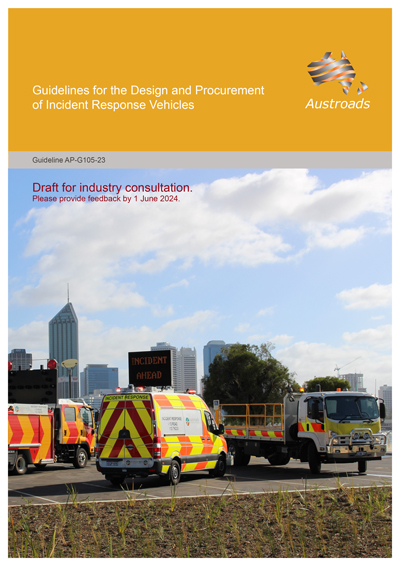
- Publication no: AP-G105-23
- ISBN: 978-1-922994-16-5
- Published: 13 December 2023
- PDF (free) Download
Incident response vehicles (IRVs) are used to attend incident sites to make the sites safer and provide recovery services to affected networks, vehicles and persons. They are tailor-made vehicles designed with specific considerations for the safety of the incident responders, road workers and road users. To support procurement process of IRVs with national consistency of practice, this guideline presents various aspects to consider when procuring IRVs.
This document provides stakeholders with guidance on models/types and design specifications of incident response vehicles. The guide focuses on three vehicle types: tow trucks, truck-mounted attenuators and utility vehicles. In general, the design considerations are separated into three stages: determining models and general specifications, determining additional features and equipment, and determining markings, signs and other identification measures to ensure visibility and identifiability of the incident response vehicles.
Note: This guidance document should be read alongside relevant standards and regulations.
Update on the Feedback
Austroads publications AP-G105‑23 Guidelines for the Design and Procurement of Incident Response Vehicles and AP‑G106‑23 Guidelines for the Use of Truck‑Mounted Attenuators in Incident Response were released as drafts for industry comment by the Austroads Network Task Force in December 2023.
Initial feedback emphasised that the main use of truck-mounted attenuators is for temporary traffic management at road worksites. In response to this feedback, the Austroads Board approved a follow‑on project, NEG6522 Guidance for the Use of Truck‑Mounted Attenuators During Temporary Traffic Management. This new guidance is currently in development by the Road Safety Task Force and is anticipated for publication in the first half of 2026.
Once the new temporary traffic management guidance is completed, Austroads will review its recommendations to determine whether AP-G105‑23 and AP‑G106‑23 should be finalised in their current form, revised, or superseded.
Webinar
- Summary
- Definitions
- Abbreviations
- 1. Introduction
- 1.1 Background
- 1.2 Purpose
- 1.3 Methodology
- 1.4 Scope
- 1.4.1 Limitations
- 1.5 How to Use This Guide
- 1.5.1 Intended Users
- 1.5.2 Standards and Guidance Documents
- 1.5.3 Guideline Structure
- 2. Approach to Design and Procurement of IRVs
- 2.1 General Principles
- 2.2 Matters for Resolution
- 2.2.1 Warning Light Colours
- 3. Tow Trucks
- 3.1 Overview
- 3.2 Selecting Tow Truck Types and Specifications
- 3.2.1 Tow Truck Types
- 3.2.2 Tow Truck Specifications
- 3.3 Selecting Tow Truck Fit-outs and Equipment
- 3.4 Markings and Identifications
- 3.5 Ongoing Maintenance
- 3.6 Tow Truck Matters for Resolution
- 3.6.1 Towing Multiple Vehicles
- 4. Truck-Mounted Attenuators (TMA)
- 4.1 Overview
- 4.2 Selecting TMA Models
- 4.2.1 TMA Selection Aspects
- 4.2.2 Specifications
- 4.3 Selecting TMA Fit-outs and Equipment
- 4.4 Markings and Identifications
- 4.5 Ongoing Maintenance
- 4.6 TMA Matters for Resolution
- 4.6.1 TMA Crash Testing
- 4.6.2 TMA Compliance
- 5. Utility Vehicles
- 5.1 Overview
- 5.2 Selecting Utility Vehicle Make and Model
- 5.2.1 Specifications
- 5.3 Selecting Fit-outs and Equipment
- 5.4 Markings and Identifications
- 5.5 Special Vehicles
- References
Austroads has released updated editions of nine parts of the Guide to Temporary Traffic Management (AGTTM). The updates make it easier to apply the guidance consistently in practice, supporting safer worksites and safer journeys for all road users.