
Tuesday, 8 July 2025
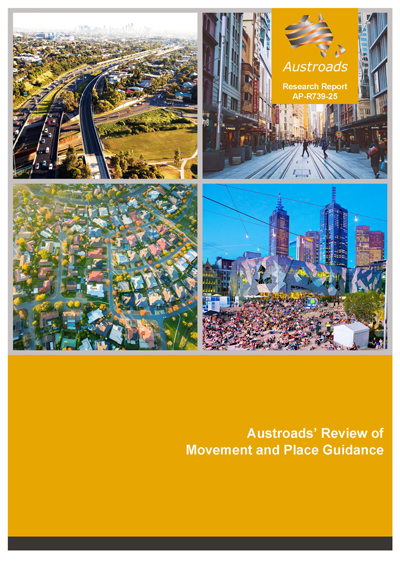
Austroads has released a new report to help transport agencies and local governments apply Movement and Place principles when planning for and operating road networks.
The report, Austroads' Review of Movement and Place Guidance, promotes greater consistency in terminology and application and draws on examples of best practice across Australia and New Zealand. It outlines recommendations to strengthen Movement and Place guidance within the Guide to Traffic Management.
Austroads Transport Network Operations Program Manager, Amy Naulls, said the recommendations respond to a clear need for improved guidance.
“Road managers across Australia and New Zealand are using Movement and Place as a framework to help optimise their networks for all users. This report supports that work by providing more consistent, practical advice.”
Movement and Place is a transport planning approach that recognises the dual function of roads and streets: to enable the efficient and safe movement of people and goods, and to serve as important places in their own right—public spaces that support local activity, character, amenity, and community interaction.
Road managers can use the framework to balance the needs of different users, modes, and places—including how a street functions at different times of day. This is particularly important in busy urban and regional areas, where space is limited but both activity and demand are high.
The Movement and Place framework also aligns transport objectives with broader social, environmental and land use goals. It helps governments and agencies make holistic, evidence-based decisions about how streets should function, who they serve, and how they could evolve over time.
Although Movement and Place principles have been reflected in several Austroads publications, existing guidance remains fragmented and does not fully capture the breadth of current practice across jurisdictions.
To address this, the report proposes a common set of terminology, core framework elements, and clearer direction for applying Movement and Place thinking. It also includes case studies demonstrating practical applications—from rural networks to strategic planning, performance monitoring and project evaluation.
“This research is about making it easier for practitioners to understand and apply Movement and Place concepts in their everyday work,” Ms Naulls said. “We’ve focused on real-world examples that reflect how this approach can be used across different contexts and scales.”
The report recommends postponing major structural changes to Guide to Traffic Management Part 4: Network Management Strategies until a full review of that section can be undertaken. In the meantime, the newly developed content can support planning and policy work, and is modular enough to be incorporated into other Austroads guidance.
This part of the Guide focuses on how transport agencies plan, operate and optimise road networks to balance the needs of different users, modes and places.
“While the network management guidance isn’t changing just yet, this advice gets us ready,” Ms Naulls said. “It means that when we do update it, the new content will be informed by consistent, tested and practical examples.”
Austroads invites practitioners, planners and policymakers to download the full report and register for the upcoming webinar to learn more about the findings and how they can be applied in practice.
Download AP-R739-25 Austroads’ Review of Movement and Place Guidance
Join the webinar
21 August 2025 at 1:00 PM AEST | Presented by Mary Haverland.
Includes live Q&A. No charge but registration is essential. Can't make the live session? Register and we'll send you a link to the recording.