
Wednesday, 24 June 2026
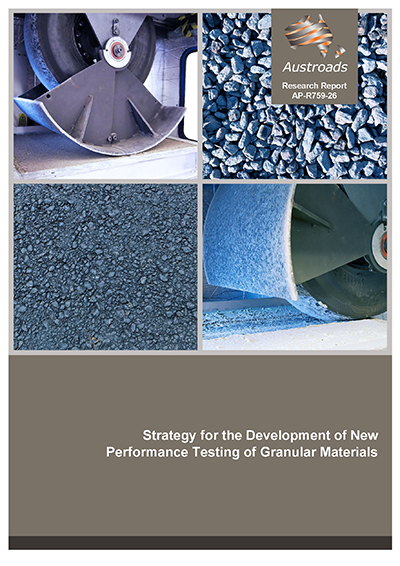
Austroads has released a new report proposing a research strategy to improve how the structural performance of unbound granular materials is tested, supporting more reliable and fit-for-purpose road construction practices.
Current testing methods have limitations in accurately assessing how granular materials perform under real-world conditions. This research identifies alternative approaches and highlights priority areas for further investigation to strengthen performance-based characterisation.
“This report sets out a strategy to improve how we assess the structural performance of unbound granular materials,” said Ross Guppy, Austroads Transport Infrastructure Program Manager.
“There is a clear need for better methods to evaluate deformation resistance and to better understand how moisture conditions influence performance, which is essential for more reliable and efficient pavement design.”
The report draws on an extensive literature review of testing methods used to assess granular materials in pavement design and construction. It evaluates the suitability of existing and emerging techniques, with a focus on practical application by road agencies and industry.
A key finding is the need to improve how moisture conditions are selected and controlled during testing, as this has a significant influence on material performance. Addressing this issue will enable more consistent comparisons and better-informed material selection.
Several methods were identified for further evaluation, including the precision unbound granular analyser (PUMA), the gyratory compactor, and the large wheel tracking device. These approaches show potential to better simulate loading conditions and improve insights into deformation and rut resistance.
The research also highlights the potential of the PUMA device to measure both stiffness and rut resistance under stress conditions that more closely replicate those experienced under traffic loading. Similarly, the gyratory compactor may offer a practical and cost-effective screening tool for assessing deformation characteristics before undertaking more detailed testing.
“By identifying viable alternative methods and outlining clear priorities for further research, the report provides a pathway to more accurate and practical testing frameworks,” concluded Ross.
Download Strategy for the Development of New Performance Testing of Granular Materials
Join the webinar
Thursday, 25 June 2026 at 1:00 PM AEST | Presented by Dr Geoff Jameson and Dr Didier Bodin. The session includes live Q&A.
No charge but registration is essential. Can't make the live session? Register and we'll send you a link to the recording.