
Connected and Automated Vehicles
- Publication no: AP-R760-26
- ISBN: 978-1-923617-46-9
- Published: 10 April 2026
- PDF (free) Download
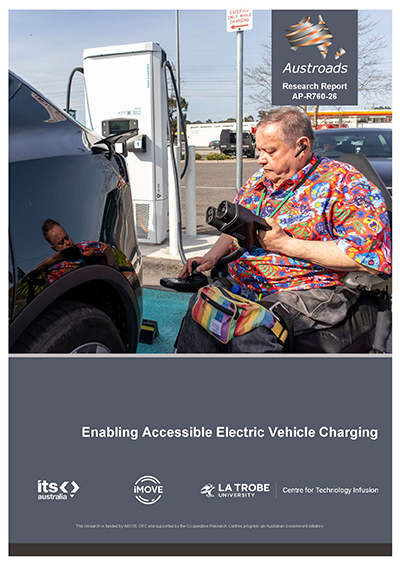
Charging a vehicle should be easy for everyone. This research report outlines how electric vehicle (EV) charging can be made more accessible for people with disability. It provides practical strategies and resources to help charging operators meet existing accessibility standards and legal obligations – while also encouraging innovation beyond compliance.
Adopting an end-user perspective, the report walks through 6 stages of the EV charging journey. It identifies common barriers faced by people with disability and offers targeted recommendations to remove or minimise these challenges.
The guidance draws on international best practices and accessibility research from the USA, Ireland, Germany, the UK and Canada, as well as primary and secondary research within Australia. It reflects input from people with disability, peak disability organisations, government stakeholders and industry partners.
The report recommendations include updates and refinements for Austroads Guidelines for Low and Zero Emission Vehicle Charging Infrastructure Installation so that they facilitate accessibility and inclusion.
Webinar
Watch a recording of the webinar to learn more.
- Summary
- Acronyms and Initialisms
- Definitions
- 1. Introduction
- 1.1 Purpose
- 1.2 Scope
- 1.3 AC versus DC charging
- 1.4 Methodology
- 1.4.1 Research activities
- 1.4.2 Frameworks that informed the research
- 2. Overview of Relevant Legislation and Existing Guidance
- 2.1 Human rights and disability laws
- 2.2 EV charging-specific standards, policies and guidelines
- 2.3 International accessible EV charging guidelines
- 2.4 Building, parking and road regulations
- 2.5 Other accessibility standards and guidelines
- 2.6 International standards
- 3. End-User Journey of EV Charging
- 3.1 Stage 1: Plan to charge vehicle
- 3.1.1 Information and communication
- 3.1.2 Duration and reservation features
- 3.1.3 Mobile applications
- 3.1.4 Opening hours, uptime and maintenance
- 3.2 Stage 2: Drive to the charging station
- 3.2.1 Distribution of charging stations
- 3.2.2 Plug types
- 3.2.3 Wayfinding and signage
- 3.2.4 Welcoming (perceived safety)
- 3.3 Stage 3: Find an available charging bay
- 3.3.1 Number of accessible bays
- 3.3.2 Positioning of charging bays
- 3.3.3 Wayfinding signage
- 3.3.4 Additional signage (‘use last’ policy)
- 3.3.5 Road marking
- 3.4 Stage 4: Charge the vehicle
- 3.4.1 Space around the vehicle
- 3.4.2 Charging point placement
- 3.4.3 Protection barriers
- 3.4.4 Even and consistent surfaces
- 3.4.5 Operating force
- 3.4.6 Sufficient cable length
- 3.4.7 Ergonomic chargers
- 3.4.8 Reach ranges
- 3.4.9 Charging unit information
- 3.4.10 Operability of charging interfaces
- 3.4.11 Assistance
- 3.5 Stage 5: Move around the site peripherals
- 3.5.1 Proximity to amenities
- 3.5.2 Avoid congestion and crowding
- 3.5.3 Lighting
- 3.5.4 Weather protection
- 3.6 Stage 6: Complete and pay
- 3.6.1 Electronic payment options
- 3.6.2 Internet availability
- 3.6.3 Identifiable payment terminal
- 3.6.4 Removing time pressure
- 3.6.5 Provisions for disability concession
- 3.6.6 Fail-safes
- 3.1 Stage 1: Plan to charge vehicle
- 4. Conclusions and Recommendations
- 4.1 Conclusions
- 4.2 Discussion and Recommendations
- 4.2.1 Regulation is required
- 4.2.2 Decide on critical points of contention
- 4.2.3 Design nationally consistent figures and diagrams
- 4.2.4 Update the current Austroads Guidelines
- 4.2.5 Create an online interactive checklist
- 4.2.6 Set up feedback loops
- 4.2.7 Funding and compliance
- References