
Pavement
- Publication no: AP-T363-22
- ISBN: 978-1-922700-30-8
- Published: 9 March 2022
- PDF (free) Download
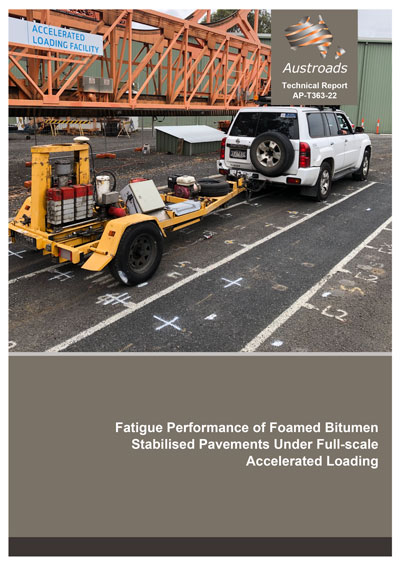
This report presents the findings of a project that evaluates the fatigue performance of foamed bitumen stabilised (FBS) pavements under accelerated loading.
Using accelerated pavement testing, the project evaluated three FBS host materials (100% crushed rock and two blends with 50% reclaimed asphalt pavement, and 80% previously cemented material). Each host material was stabilised with 3% bitumen and 2% hydrated lime. Accelerated loading cumulated over 3.6 million axle passes applied through a dual-wheel assembly initially loaded to 40 kN, and later increased to 60 kN.
The inclusion of 50% RAP increased the fatigue performance without detrimental effect on rut resistance. Whilst the average field fatigue performance of the previously cemented stabilised mix was similar to that of 100% crushed rock, performance variability needs further consideration on a risk-based basis for highly stressed applications.
This report proposes a new definition for FBS design modulus and developing improved in-service fatigue relationships for structural thickness design of FBS layers. These relationships will utilise new laboratory fatigue relationships together with laboratory-to-field shift factors developed to reflect in-service performance.
- Summary
- 1. Introduction
- 1.1 Background
- 1.2 Purpose
- 1.3 Scope
- 1.4 Methodology
- 1.5 Structure of the Report
- 2. Material Selection
- 2.1 Host Materials Selection
- 2.2 Mix Design
- 2.2.1 Indirect Tensile Modulus Requirements
- 2.2.2 Bituminous Binder Testing
- 2.2.3 Indirect Tensile Modulus Testing
- 2.3 Surfacing of the FBS Base
- 3. Test Site Construction
- 3.1 Location
- 3.2 Layout of Test Lanes
- 3.3 Test Pavement Structures
- 3.4 Construction
- 3.4.1 Concrete Tank
- 3.4.2 Imported Subgrade
- 3.4.3 Subbase
- 3.4.4 FBS Base Layers
- 3.4.5 Sprayed Seal Surface
- 3.5 Pavement Construction Evaluation
- 3.5.1 Construction Sample Testing
- 3.5.2 FBS Base Thickness
- 3.6 Preparation of Test Lanes for Testing
- 4. Pavement Curing Prior to Accelerated Loading
- 4.1 Introduction
- 4.2 FBS Curing Monitoring Before Trafficking
- 4.3 Continued Monitoring of Curing
- 5. Accelerated Pavement Testing Overview
- 5.1 Introduction
- 5.2 Loading Condition
- 5.3 Trafficking Monitoring
- 5.4 Environmental Conditions
- 5.4.1 Meteorological Data
- 5.4.2 Pavement Temperature Monitoring
- 5.5 Pavement Performance Monitoring
- 5.5.1 Pavement Surface Deflection Testing
- 5.5.2 Surface Cracking
- 5.5.3 Surface Deformation Monitoring
- 5.5.4 Coring for Field Material Laboratory Testing
- 6. Overall Pavement Performance
- 6.1 General
- 6.2 Visual Pavement Surface Assessment
- 6.3 Post-trafficking Pavement Investigation
- 6.3.1 Trenching and Cracking Evaluation
- 6.3.2 Post-trafficking Field Material Evaluation
- 6.4 Deformation Performance
- 6.4.1 Pavement Surface Deformation
- 6.4.2 Post-trafficking FBS Layer Thickness Evaluation
- 6.5 Overall Pavement Performance Summary
- 7. Laboratory Properties of FBS Mixes
- 7.1 Introduction
- 7.2 Laboratory Characterisation of the Field Materials
- 7.2.1 Sampling of Field Material
- 7.2.2 Density Correction of FBS Modulus Data
- 7.2.3 IT Modulus of Field Cores: Curing
- 7.2.4 IT Modulus of Field Cores: Temperature Sensitivity
- 7.2.5 Flexural Modulus of Field Beams
- 7.3 Mechanical Properties of Laboratory Manufactured Beams
- 7.3.1 Laboratory Flexural Modulus and Strength
- 7.3.2 Laboratory Flexural Fatigue Performance
- 8. Pavement Fatigue Damage Analysis
- 8.1 General
- 8.2 Analysis Method
- 8.2.1 FBS Layer Modulus Change with Time and Loading
- 8.2.2 FBS Pavement Temperature Characterisation
- 8.3 FBS Modulus Back-calculation
- 8.3.1 Back-calculation Process
- 8.3.2 Initial Back-calculated Moduli
- 8.4 Fatigue Damage Analysis
- 8.4.1 Equivalent Pavement Loading
- 8.4.2 Damage Exponent
- 8.4.3 Modulus Ratio Approach
- 8.4.4 Estimated Fatigue Lives
- 8.4.5 Summary
- 9. Fatigue Performance Relationships
- 9.1 Performance Relationship from Field Data
- 9.1.1 Estimation of the Initial Tensile Strain and Stress in the FBS Layer
- 9.1.2 Fatigue Lives vs Stress or Strain Relationships
- 9.2 Comparison with Laboratory Fatigue Relationship
- 9.3 Summary of Findings
- 9.1 Performance Relationship from Field Data
- 10. Project Findings and Current Mix Design Practice
- 10.1 Performance of FBS Recycled Material Blends
- 10.1.1 Introduction
- 10.1.2 Performance of FBS mixes with High RAP Content
- 10.1.3 FBS of Previously Cement Treated Materials
- 10.2 Mix Design Moduli vs In situ Moduli
- 10.3 Proposed Performance-based Design Framework
- 10.1 Performance of FBS Recycled Material Blends
- 11. Conclusions
- References
- Appendix A APT and Pavement Monitoring Schedule
- Appendix B Deformation Data
- B.1 Profilometry Deformation Data
- B.2 FBS Layer Thickness Data
- Appendix C Temperature Processing
- Appendix D Curing Data and Modelling
- D.1 Introduction
- D.2 Laboratory Testing of Field Cores
- D.3 Material Curing Model Fitting
- D.4 Prediction of the Untrafficked Back-calculated Moduli
- Appendix E Field Material Temperature Susceptibility
- E.1 IT Modulus at Varying Temperatures
- E.2 Temperature Model Calibration
- Appendix F Initial Back-calculated Moduli and Initial Pavement Response
- F.1 Initial Back-calculated Moduli
- F.2 Predicted Initial Strain and Stress
- Appendix G Damage Analysis Graphs
- G.1 Overall Behaviour of Uniform Sections
- G.2 Behaviour for Individual Chainages
- G.2.1 Modulus Ratio Model Parameters
- G.2.2 Modulus Ratio Graphs
- Appendix H Post-trafficking Investigations
- H.1 Properties of Unbound and Subgrade Layers
- H.2 Analysis of Field Cores
- H.2.1 Sampling
- H.2.2 Density Evaluation for Field Cores
- H.2.3 Indirect Tensile Modulus Testing of Field Cores
- H.3 Trenching and Post-trafficking Cracking Observation