
Pavement
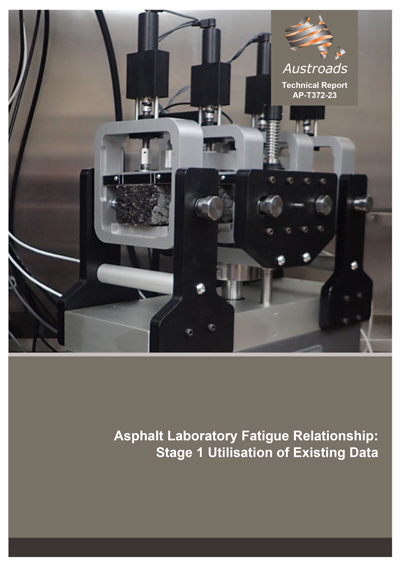
- Publication no: AP-T372-23
- ISBN: 978-1-922700-72-8
- Published: 15 March 2023
- PDF (free) Download
This report documents the findings of the first stage of an Austroads project which aims to benchmark the laboratory fatigue performance of locally manufactured asphalt mixes against the performance predicted by the Shell relationship in Austroads structural pavement design guidance.
The report details the results of a literature review and the collation and analysis of modulus and fatigue data provided by several road agencies and asphalt suppliers. The analysis undertaken concluded that the Shell laboratory fatigue relationship was not necessarily a good predictor of the fatigue performance of the mixes included in the study. Consequently, new preliminary fatigue relationships (subject to further research) were developed for conventional dense graded asphalt and EME2 asphalt.
The project also identified limitations with current methods used to reliably predict the fatigue life of asphalt manufactured with polymer modified binders.
Watch a webinar with researchers Joe Grobler and Dr Negin Zhalehjoo and project manager Peter Bryant.
- Summary
- 1. Introduction
- 1.1 Purpose
- 1.2 Scope
- 1.3 Methodology
- 2. Literature Review
- 2.1 Asphalt Design Moduli
- 2.1.1 Australian and New Zealand Practice)
- 2.1.2 Selected International Practices
- 2.2 Asphalt Fatigue Relationships
- 2.2.1 Australia and New Zealand)
- 2.2.2 Selected International Practices
- 2.3 Laboratory versus Plant Mixed Asphalt Samples
- 2.4 Minimum Number of Test Specimens Required to Develop a Laboratory Asphalt Fatigue Relationship
- 2.1 Asphalt Design Moduli
- 3. Available Modulus and Fatigue Laboratory Data
- 4. Factors Affecting Laboratory Fatigue Life
- 4.1 Effect of Sample Preparation Method on Fatigue Life (LMLC vs PMLC Specimens)
- 4.2 Effect of RAP on Fatigue Life
- 4.2.1 Fatigue Life of Asphalt with Conventional Binder and RAP
- 4.2.2 DGA with PMB and RAP
- 4.3 Number of Test Specimens
- 5. Analysis of the Fatigue Data
- 5.1 Comparison between Laboratory Fatigue Results and the Shell Fatigue Relationship
- 5.1.1 Predicted Fatigue Life Based on Measured Flexural Moduli
- 5.1.2 Predicted Fatigue Life Based on Presumptive Moduli
- 5.2 Analysis of the Laboratory Fatigue Life of Australian and New Zealand Asphalt
- 5.2.1 Fatigue Life of Asphalt with Conventional Binders
- 5.2.2 Fatigue Life of Asphalt with PMBs
- 5.1 Comparison between Laboratory Fatigue Results and the Shell Fatigue Relationship
- 6. Development of New Preliminary Laboratory Fatigue Relationships
- 6.1 DGA with Conventional Binders and Without RAP
- 6.2 DGA with Conventional Binders and up to 15% RAP
- 6.3 EME2 Asphalt Without RAP
- 6.4 EME2 Asphalt with 10% RAP
- 6.5 Asphalt with PMBs
- 6.6 Limitations of the Analysis and Modelling
- 7. Summary, Conclusions and Further Research Required
- 7.1 Summary and Conclusions
- 7.1.1 Characterising the Modulus and Fatigue Behaviour of Asphalt – Current Practice
- 7.1.2 Factors Affecting the Laboratory Fatigue Life of Asphalt
- 7.1.3 Laboratory Fatigue Life versus Fatigue Life Predicted by the Shell Relationship
- 7.1.4 New Preliminary Laboratory Fatigue Relationships
- 7.2 Further Research Required
- 7.1 Summary and Conclusions
- References
- Appendix A Effect of Minimum Number of Test Specimens – Statistical Analysis
- Appendix B Data Used for Regression Analysis
- B.1 DGA with Conventional Binders Without RAP
- B.2 DGA with Conventional Binders and RAP
- B.3 EME2 Asphalt Without RAP
- B.4 EME2 Asphalt and RAP