
Pavement
- Publication no: AP-T382-25
- ISBN: 978-1-922994-83-7
- Published: 15 August 2025
- PDF (free) Download
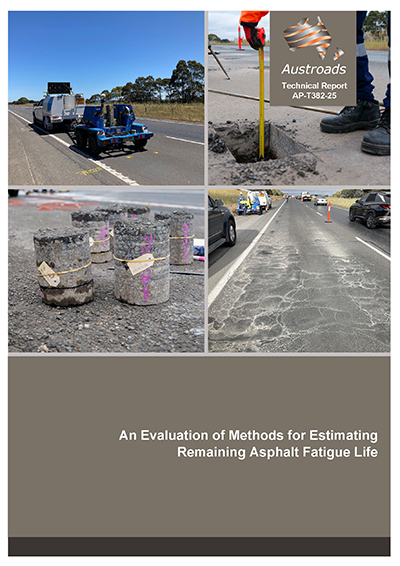
This report investigates ways to improve the mechanistic-empirical procedure for designing pavement rehabilitation by incorporating estimates of the remaining fatigue life of existing bound materials.
While continuous advancements in material characterisation, pavement modelling and traffic analysis have established a robust mechanistic‑empirical procedure for the design of new and rehabilitated pavements, current design practices assume no remaining fatigue life in bound layers.
This report presents the findings of Austroads project APT6329, which investigated the remaining fatigue properties of existing asphalt layers in pavement treatments. The project assessed two existing fatigue life assessment methods against the in-service performance of a thick asphalt pavement on a national highway. A detailed pavement investigation was undertaken, including surface deflection testing within and between wheel paths, material sampling, and laboratory testing of asphalt cores for laboratory modulus and fatigue performance.
Based on these findings, a framework was developed to support rehabilitation treatment designs that consider the remaining fatigue life of existing asphalt layers.
Watch a recording of the webinar to learn more.
- Summary
- 1. Introduction
- 1.1 Purpose
- 1.2 Scope
- 1.3 Methodology
- 1.4 Structure of the report
- 2. Overview of Methods Investigated
- 2.1 Background
- 2.2 Reduction in existing bound material modulus due to past traffic
- 2.3 Reduction of laboratory fatigue life of existing bound materials
- 3. Pavement Test Site
- 3.1 Test pavement requirements
- 3.2 Test site selection
- 3.3 Pavement composition
- 4. Sampling and Testing Program
- 4.1 Field sampling and testing
- 4.2 Laboratory testing
- 4.2.1 Sample preparation
- 4.2.2 Indirect tensile modulus testing
- 4.2.3 Indirect tensile fatigue testing
- 4.2.4 Material characterisation
- 5. Detailed Field Observations
- 5.1 Visual condition survey
- 5.2 Surface deflection results
- 5.3 Asphalt thickness results
- 5.4 Estimated subgrade CBR results
- 5.5 Test pit results
- 6. Asphalt Core Testing Results
- 6.1 Presence of pumped fines
- 6.2 Indirect tensile modulus results
- 6.2.1 Air voids variations
- 6.2.2 Outliers
- 6.2.3 Effect of loading direction
- 6.2.4 Predicting remaining life using core moduli
- 6.3 Indirect tensile fatigue results
- 6.3.1 Test conditions
- 6.3.2 Predicting remaining life from core fatigue results
- 6.4 Material characterisation results
- 7. Moduli Back-calculated from FWD Deflections
- 7.1 Introduction
- 7.3 Modulus results
- 7.4 Effect of trafficking on back-calculated moduli
- 7.5 Comparison of back-calculated moduli with core moduli
- 8. Discussion
- 8.1 Usefulness of field core moduli and fatigue measurements
- 8.2 Back-calculated moduli link to fatigue damage
- 8.3 Framework for implementation in Austroads mechanistic-empirical procedure
- 8.4 Further research
- 9. Summary and Recommendation
- References
- Appendix A Test Site Photographs
- Appendix B Falling Weight Deflectometer Surface Deflection Data
- Appendix C Dynamic Cone Penetrometer Test Results
- Appendix D Test Pit Photographs
- Appendix E Indirect Tensile Modulus Results
- E.1 Indirect tensile modulus ratio
- Appendix F Specimen Outliers
- Appendix G Effect of Pumped Fines
- G.1 Modulus results excluding cores with high pumped fines
- G.2 Fatigue results excluding cores with high pumped fines
- Appendix H Fatigue Results
- Appendix I Back-calculated Moduli
- I.1 Composite modulus
- I.2 Seed moduli for subgrade layer 3
- I.3 Back-calculated modulus
- Appendix J Computer Tomography Scan Results
- Appendix K Possible Changes to the Mechanistic-Empirical Procedure in Austroads Guide to Pavement Technology Part 5
- Appendix L Asphalt Overlay Design Example Considering Remaining Asphalt Fatigue Life
- L.1 Introduction
- L.2 Procedure
- Appendix M Selected Literature Reviews
- M.1 Introduction
- M.2 Use of indirect tensile fatigue testing to determine fatigue life
- M.3 Asphalt ageing
- M.3.1 Background
- M.3.2 Factors determining ageing
- M.3.3 Influence of ageing on behaviour
- M.4 Modelling ageing effect on modulus
- M.4.1 CalME 2.0 stiffness ageing model
- M.4.2 National Cooperative Highway Research Program (NCHRP) model
- M.5 Modelling ageing effect on fatigue
- M.6 Conclusions