
Road Safety
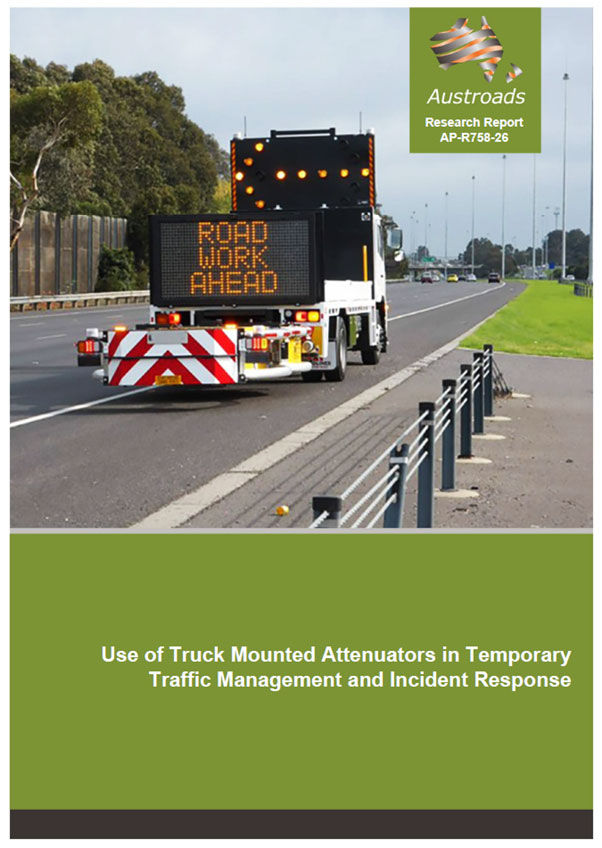
- Publication no: AP-R758-26
- ISBN: 978-1-923617-33-9
- Published: 27 February 2026
- PDF (free) Download
The purpose of this research report is to document the findings of stakeholder consultation and review of literature undertaken to inform the development of guidance for the use of truck mounted attenuators (TMAs) for planned Temporary Traffic Management (TTM) and incident response (IR) activities. This report examines TMA effectiveness, products and devices, design, implementation, operation, training, psychological safety, fleet management and technology.
The literature review found that guidance for TMAs is inconsistent and limited. The wide range of applications of TMAs for different road environments and the differences between TTM and IR applications indicated a need for designers and operators to have appropriate information to make risk-based decisions for site specific conditions. The stakeholder consultation process further identified that approaches to designing, operating and implementing TMAs response varies between jurisdictions.
This report highlights the industry need for risk-based guidance on a range of issues relating to TMA use for planned TTM and IR activities.
- 1. Introduction
- 1.1 Purpose
- 1.2 Scope
- 1.3 Structure
- 1.4 Definitions
- 1.5 Methodology
- 1.5.1 Phase 1 – Project planning and research questions
- 1.5.2 Phase 2 – Stakeholder engagement and industry consultation
- 1.5.3 Phase 3 – Literature review
- 1.5.4 Phase 4 – Synopsis
- 1.5.5 Phase 5 – Synthesis
- 1.5.6 Phase 6 – Report preparation
- 2. TMA Fundamentals
- 2.1 TMA introduction
- 2.2 Temporary Traffic Management
- 2.3 Incident Response
- 2.4 TMAs in planned TTM
- 2.4.1 Static works using TMAs
- 2.4.2 Mobile works using TMAs
- 2.4.3 Short term low impact works
- 2.5 TMAs in Incident Response
- 2.5.1 Static treatments
- 2.5.2 Rolling blockades
- 2.6 Fundamental concepts
- 2.6.1 Advance warning zone
- 2.6.2 Driver sight distance
- 2.6.3 TMA operator sight distance
- 2.6.4 Transition zone
- 2.6.5 Kinetic energy transfer
- 2.6.6 Roll-ahead distance
- 2.6.7 Exclusion zone
- 2.6.8 Adjacent clearance
- 2.6.9 Lateral placement of a TMA
- 2.6.10 Work area intrusion
- 2.6.11 Zone of protection
- 2.6.12 Termination zone
- 3. Stakeholders
- 3.1 General overview
- 3.2 Research questions
- 3.3 Industry survey
- 3.4 Synopsis
- 3.4.1 Austroads member agencies
- 3.4.2 National Heavy Vehicle Regulator
- 3.4.3 Standards Australia Committee CE-33 – Road Safety Barriers
- 3.4.4 Austroads Safety Barrier Assessment Panel
- 3.4.5 Jurisdictional licensing and registration authorities
- 3.4.6 Manufacturers and distributors
- 3.4.7 Road infrastructure managers
- 3.4.8 TTM companies
- 3.4.9 Incident Response contractors
- 3.5 Synthesis
- 4. Literature
- 4.1 General overview
- 4.2 Research and sources reviewed
- 4.2.1 Research questions
- 4.2.2 Austroads jurisdictions guidance
- 4.2.3 International standards and guidance
- 4.2.4 Manufacturers documentation
- 4.2.5 Research documentation
- 4.3 Summary of findings
- 5. Products, Vehicles and Devices
- 5.1 General overview
- 5.2 Research and sources reviewed
- 5.2.1 Research questions
- 5.2.2 Literature review
- 5.2.3 Stakeholder consultation
- 5.3 Summary of findings
- 5.3.1 Attenuator testing protocols
- 5.3.2 Impact attenuator units
- 5.3.3 Trailer truck mounted attenuators
- 5.3.4 Host vehicle specifications
- 6. Effectiveness of TMAs
- 6.1 General overview
- 6.2 Research and sources reviewed
- 6.2.1 Research questions
- 6.2.2 Literature review
- 6.2.3 Stakeholder consultation
- 6.3 Summary of findings
- 6.3.1 Impact probability
- 6.3.2 Safety and outcomes
- 6.3.3 Roll-ahead distance
- 6.3.4 Effectiveness issues
- 7. Design of TTM for the use of TMAs
- 7.1 General overview
- 7.2 Research and sources reviewed
- 7.2.1 Research questions
- 7.2.2 Literature review
- 7.2.3 Stakeholder consultation
- 7.2.4 Industry survey
- 7.3 Summary of findings
- 7.3.1 Risk management
- 7.3.2 Road environments
- 7.3.3 Static worksites
- 7.3.4 Mobile worksites
- 7.3.5 Short term low impact worksites
- 7.3.6 Design for IR
- 7.3.7 Design guidance
- 7.3.8 Communicating design information
- 8. TMA Operation
- 8.1 General overview
- 8.2 Research and sources reviewed
- 8.2.1 Research questions
- 8.2.2 Literature review
- 8.2.3 Stakeholder consultation
- 8.2.4 Industry survey
- 8.3 Summary of findings
- 8.3.1 Pre-shift activities
- 8.3.2 Travel and deployment
- 8.3.3 On-site operational protocols
- 8.3.4 Stowing and return to depot
- 8.3.5 Incident Response
- 8.3.6 Operational guidance
- 9. Psychological Safety for TMAs
- 9.1 General overview
- 9.2 Research and sources reviewed
- 9.2.1 Research questions
- 9.2.2 Literature review
- 9.2.3 Stakeholder consultation
- 9.2.4 Industry survey
- 9.3 Summary of findings
- 9.3.1 Psychosocial hazards
- 9.3.2 Potentially traumatic event
- 9.3.3 Immediate impact response
- 9.3.4 Post-impact aftercare and return-to-work protocols
- 10. Training for TMAs
- 10.1 General overview
- 10.2 Research and sources reviewed
- 10.2.1 Research questions
- 10.2.2 Literature review
- 10.2.3 Stakeholder consultation
- 10.2.4 Industry survey
- 10.3 Summary of findings
- 10.3.1 Operator training
- 10.3.2 Designer training
- 10.3.3 Incident Response training
- 10.3.4 Adjacent training
- 11. Fleet Management of TMAs
- 11.1 General overview
- 11.2 Research and sources reviewed
- 11.2.1 Research questions
- 11.2.2 Literature review
- 11.2.3 Stakeholder consultation
- 11.2.4 Industry survey
- 11.3 Summary of findings
- 11.3.1 Roles and responsibilities
- 11.3.2 Economics
- 11.3.3 Servicing and inspection
- 11.3.4 Post-impact repair and replacement
- 12. TMA Technology
- 12.1 General overview
- 12.2 Research and sources reviewed
- 12.2.1 Research questions
- 12.2.2 Literature review
- 12.2.3 Stakeholder engagement
- 12.3 Summary of findings
- 12.3.1 Transferable technologies
- 12.3.2 Light TMAs
- 12.3.3 TMA outrigger arms
- 12.3.4 Leader-follower ATMAs and remote-controlled TMAs
- 12.3.5 Vehicle electrification
- 13. Recommendations and Next Steps
- 14. Conclusions
- References
- Appendix A Stakeholder Register
- Appendix B Literature Register
- Appendix C Industry Survey Results
- Appendix D Jurisdictional TMA Host Vehicle Specifications