
Road Safety
Addressing High-Risk Crash Locations
- Publication no: AP-TN18-26
- Published: 15 May 2026
- Edition: 1.0
- PDF (free) Download
This Austroads Technical Note covers the treatment of high-risk crash locations. It covers topics including the use of road crash data, identifying crash locations, diagnosing issues and exploring treatment options.
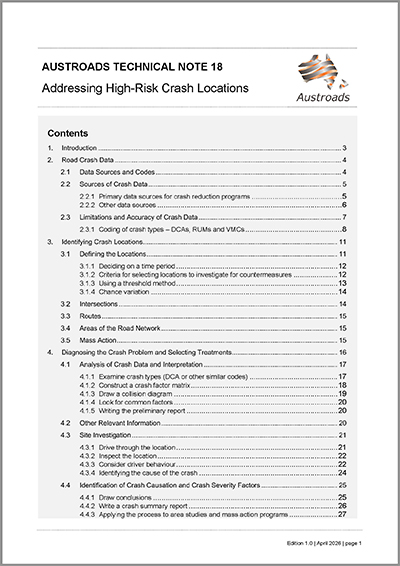
- 1. Introduction
- 2. Road Crash Data
- 2.1 Data Sources and Codes
- 2.2 Sources of Crash Data
- 2.2.1 Primary data sources for crash reduction programs
- 2.2.2 Other data sources
- 2.3 Limitations and Accuracy of Crash Data
- 2.3.1 Coding of crash types – DCAs, RUMs and VMCs
- 3. Identifying Crash Locations
- 3.1 Defining the Locations
- 3.1.1 Deciding on a time period
- 3.1.2 Criteria for selecting locations to investigate for countermeasures
- 3.1.3 Using a threshold method
- 3.1.4 Chance variation
- 3.2 Intersections
- 3.3 Routes
- 3.4 Areas of the Road Network
- 3.5 Mass Action
- 3.1 Defining the Locations
- 4. Diagnosing the Crash Problem and Selecting Treatments
- 4.1 Analysis of Crash Data and Interpretation
- 4.1.1 Examine crash types (DCA or other similar codes)
- 4.1.2 Construct a crash factor matrix
- 4.1.3 Draw a collision diagram
- 4.1.4 Look for common factors
- 4.1.5 Writing the preliminary report
- 4.2 Other Relevant Information
- 4.3 Site Investigation
- 4.3.1 Drive through the location
- 4.3.2 Inspect the location
- 4.3.3 Consider driver behaviour
- 4.3.4 Identifying the cause of the crash
- 4.4 Identification of Crash Causation and Crash Severity Factors
- 4.4.1 Draw conclusions
- 4.4.2 Write a crash summary report
- 4.4.3 Applying the process to area studies and mass action programs
- 4.5 Countermeasure Selection and Design
- 4.5.1 What is a safe road environment?
- 4.5.2 Safe System treatments
- 4.5.3 Speed management
- 4.5.4 Enforcement
- 4.5.5 Match the solutions to the problems
- 4.5.6 Select the solutions
- 4.1 Analysis of Crash Data and Interpretation
- 5. References
Related publications
AGRS-SET
AGRS02-24
Latest Road Safety News