
Test Methods and Specifications
- Publication no: ATM-458-25
- Published: 21 May 2025
- Edition: 1.1
- PDF (free) Download
This test method sets out the procedure for the determination of the suitability of a recycled plastic to be used as construction material in asphalt pavements.
This test method is applicable to thermoplastic polymers, such as poly(ethylene) (PE), poly(propylene) (PP), poly(ethylene terephthalate) (PET), acrylonitrile butadiene styrene (ABS), poly(amide) 6/6 (PA 6/6) and their blends recycled from industrial and/or post-consumer commingled streams. Polyvinyl chloride (PVC) and polystyrene (PS) are excluded from this test method.
This test method is intended to identify recycled plastic materials suitable for incorporation in asphalt as a bitumen modifier (wet method), asphalt modifier (mixed method) or aggregate substitute (dry method). Note that a complete description of the 3 incorporation methods is available in the Austroads report AP-R663-21 Use of Road-grade Recycled Plastics for Sustainable Asphalt Pavements: Towards the Selection of Road-grade Plastics – An Evaluation Framework and Preliminary Experimental Result. Four criteria are considered, including the melting points and melt flow index of the recycled plastics, as well as the amount of fillers and the presence of brominated flame retardants, phthalates and heavy metals in the plastic materials, i.e. contaminants.
A comparison between the melting point of recycled plastics and the working temperature of bitumen/asphalt allows for the identification of the best method for incorporating recycled plastic. The melt flow index of recycled plastics constitutes a quality control test to ascertain variability between batches and determines the workability of the recycled plastics. The presence of excessive fillers is determined to avoid any potential impact on the bitumen/asphalt performance. The determination of contaminants potentially harmful to workers and the environment in plastic-modified bituminous materials, including brominated diphenyl ethers (BDE), phthalates and heavy metals, allows for the potential safety risks of using recycled plastics in bitumen/asphalt to be assessed.
This test method can also be downloaded as a Word document.
Edition 1.1 published May 2025
- Edition 1.1 corrects two cross-references to tables in Sections 6.5.1 (b) and 6.5.1 (u).
Edition 1.0 published May 2025
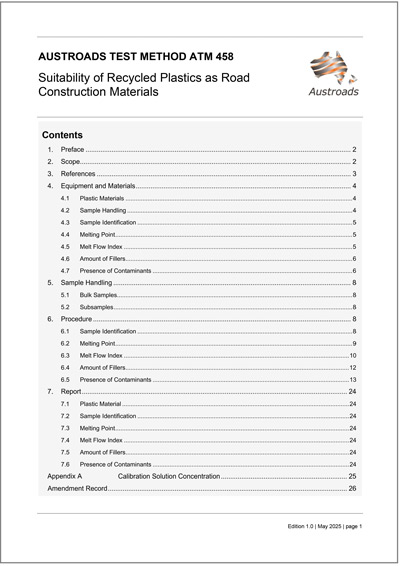
- 1. Preface
- 2. Scope
- 3. References
- 4. Equipment and Materials
- 4.1 Plastic Materials
- 4.2 Sample Handling
- 4.2.1 Bulk Samples
- 4.2.2 Subsamples
- 4.3 Sample Identification
- 4.4 Melting Point
- 4.5 Melt Flow Index
- 4.6 Amount of Fillers
- 4.7 Presence of Contaminants
- 4.7.1 Brominated Diphenyl Ethers (BDE)
- 4.7.2 Heavy Metals
- 4.7.3 Phthalates
- 5. Sample Handling
- 5.1 Bulk Samples
- 5.2 Subsamples
- 6. Procedure
- 6.1 Sample Identification
- 6.2 Melting Point
- 6.3 Melt Flow Index
- 6.3.1 Procedure
- 6.3.2 Calculation
- 6.4 Amount of Fillers
- 6.4.1 Procedure
- 6.4.2 Calculations
- 6.5 Presence of Contaminants
- 6.5.1 Brominated Diphenyl Ethers (BDE)
- 6.5.2 Heavy Metals
- 6.5.3 Phthalates
- 7. Report
- 7.1 Plastic Material
- 7.2 Sample Identification
- 7.3 Melting Point
- 7.4 Melt Flow Index
- 7.5 Amount of Fillers
- 7.6 Presence of Contaminants
- Appendix A Calibration Solution Concentration