
Bridges
- Publication no: ABC2025-146-25
- Published: 27 June 2025
- PDF (free) Download
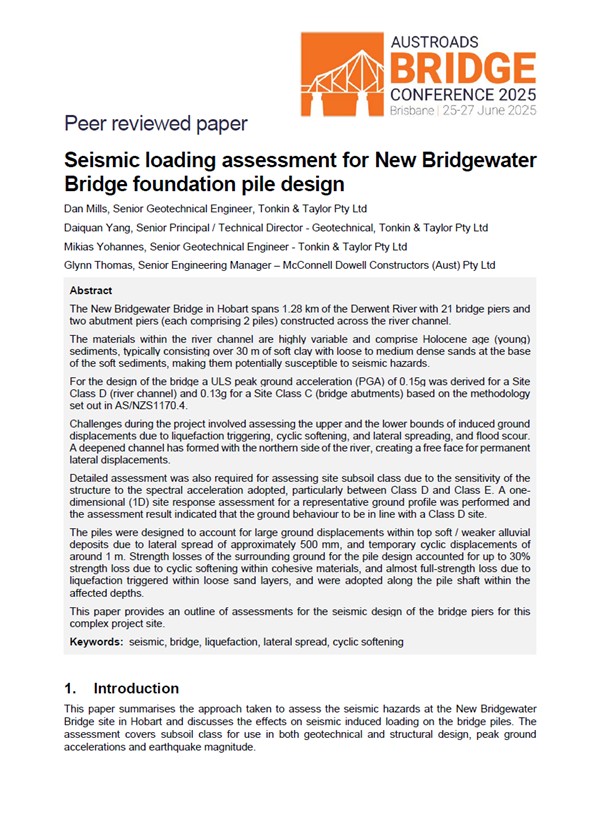
The New Bridgewater Bridge in Hobart spans 1.28 km of the Derwent River with 21 bridge piers and two abutment piers (each comprising 2 piles) constructed across the river channel. The materials within the river channel are highly variable and comprise Holocene age (young) sediments, typically consisting over 30 m of soft clay with loose to medium dense sands at the base of the soft sediments, making them potentially susceptible to seismic hazards.
For the design of the bridge a ULS peak ground acceleration (PGA) of 0.15g was derived for a Site
Class D (river channel) and 0.13g for a Site Class C (bridge abutments) based on the methodology
set out in AS/NZS1170.4. Challenges during the project involved assessing the upper and the lower bounds of induced ground displacements due to liquefaction triggering, cyclic softening, and lateral spreading, and flood scour. A deepened channel has formed with the northern side of the river, creating a free face for permanent lateral displacements.
Detailed assessment was also required for assessing site subsoil class due to the sensitivity of the structure to the spectral acceleration adopted, particularly between Class D and Class E. A onedimensional (1D) site response assessment for a representative ground profile was performed and the assessment result indicated that the ground behaviour to be in line with a Class D site.
The piles were designed to account for large ground displacements within top soft/weaker alluvial deposits due to lateral spread of approximately 500 mm, and temporary cyclic displacements of around 1 m. Strength losses of the surrounding ground for the pile design accounted for up to 30% strength loss due to cyclic softening within cohesive materials, and almost full-strength loss due to liquefaction triggered within loose sand layers, and were adopted along the pile shaft within the affected depths.
This paper provides an outline of assessments for the seismic design of the bridge piers for this complex project site.