
Bridges
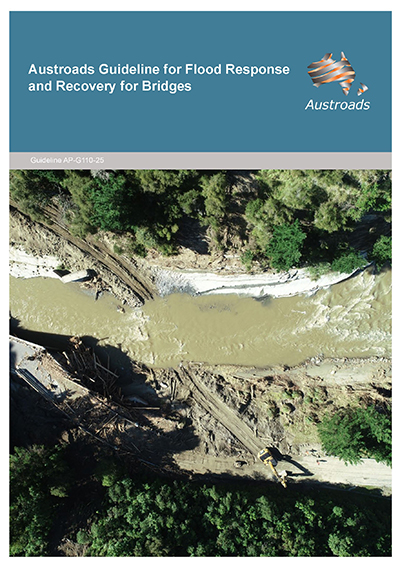
- Publication no: AP-G110-25
- ISBN: 978-1-922994-93-6
- Published: 27 October 2025
- PDF (free) Download
This Guideline provides a framework for managing risks to bridge infrastructure caused by floods, focusing on improving resilience, operational performance safety. It aims to equip engineers, asset managers, and decision-makers with strategies to address flood-related challenges, particularly those associated with scour and structural vulnerability.
The methodology involved a review of national and international best practices, consultation with hydrology experts and stakeholders, and analysis of case studies. The Guideline incorporates approaches for assessing scour risks, managing operations during floods, and ensuring post-event recovery. Practical recommendations were developed using insights from hydrological models, monitoring technologies, and field-tested strategies.
The Guideline highlights proactive measures, such as pre-flood inspections, prioritising critical bridges, and real-time monitoring during floods. Post-flood recovery focuses on condition assessments, load testing, and criteria for safe reopening.
As a living document, this Guideline will evolve with advances in research and stakeholder feedback. It provides a practical approach to safeguarding bridge infrastructure, ensuring public safety, and maintaining transport network continuity during and after flood events.
Watch a recording of the webinar to learn more.
- Summary
- 1. Introduction
- 1.1 Purpose
- 1.2 Scope
- 1.3 Methodology
- 2. Flood Impacts on Bridge Infrastructure
- 2.1 Overview of flood damage mechanisms
- 2.1.1 Hydrodynamic forces
- 2.1.2 Debris accumulation
- 2.1.3 Long-term flood exposure
- 2.1.4 Structural failure modes
- 2.2 Role of bridges
- 2.2.1 Critical infrastructure
- 2.2.2 Vulnerability of isolated communities
- 2.2.3 Role of temporary structures
- 2.3 Impact of recurring extreme weather events
- 2.3.1 Increasing flood frequency
- 2.3.2 Cumulative effects on bridge infrastructure
- 2.3.3 Need for resilient design
- 2.1 Overview of flood damage mechanisms
- 3. Scour Risk Assessment and Management
- 3.1 Identification of scour-susceptible sites
- 3.1.1 Understanding scour vulnerability
- 3.1.2 Pre-flood site assessments
- 3.1.3 Key visual indicators at the bridge for scour vulnerability
- 3.2 Methods for scour risk and impact assessment
- 3.2.1 Hydrological and hydraulic models
- 3.2.2 Scour depth prediction methods
- 3.2.3 Use of remote sensing and technology
- 3.2.4 Risk-based scour assessment
- 3.3 Practical scour risk assessment framework
- 3.3.1 Framework structure
- 3.3.2 Data requirements for scour risk assessment
- 3.3.3 Monitoring and reassessment
- 3.4 Scour treatment options and mitigation measures
- 3.4.1 Overview of scour mitigation measures
- 3.4.2 Selecting the appropriate scour treatment
- 3.1 Identification of scour-susceptible sites
- 4. Bridge Management for Flood Events
- 4.1 Operational management pre-flood
- 4.1.1 Pre-flood inspections
- 4.1.2 Risk-based bridge categorisation
- 4.1.3 Bridge prioritisation framework
- 4.1.4 Preventive maintenance
- 4.1.5 Operational flood readiness plans
- 4.1.6 Decision-making frameworks for bridge closures and reopening
- 4.2 Operational management during flood events
- 4.2.1 Safety-first approach
- 4.2.2 Real-time monitoring and data collection
- 4.2.3 Applying decision-making frameworks for bridge closures
- 4.2.4 Traffic and evacuation management
- 4.2.5 Coordination between agencies
- 4.3 Operational management post-flood
- 4.3.1 Immediate post-flood inspections
- 4.3.2 Structural integrity assessments
- 4.3.3 Reopening bridges
- 4.3.4 Prioritising repair work
- 4.3.5 Temporary structures and traffic solutions
- 4.1 Operational management pre-flood
- 5. Conclusions and Recommendations
- 5.1 Conclusions
- 5.2 Recommendations
- References