
Freight
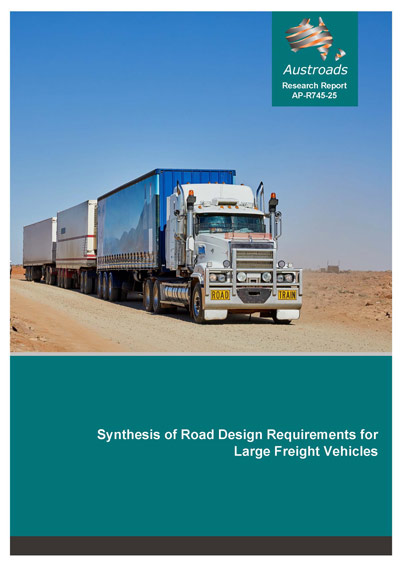
Synthesis of Road Design Requirements for Large Freight Vehicles
- Publication no: AP-R745-25
- ISBN: 978-1-923617-01-8
- Published: 4 December 2025
- PDF (free) Download
This research report is intended to inform decision-making for planning design and policy direction for road managers to accommodate increased dimensions of current and future freight vehicles. It is part of a broader initiative to capture the benefit of more efficient freight vehicles to be used on the road network.
This report focuses on where Austroads guidelines need to be updated to accommodate the increased dimensions of large freight vehicles that are currently operating and are expected to operate on Australian and New Zealand road networks.
This report seeks to provide a clear understanding of:
- modern freight vehicles’ design requirements
- current guidance and knowledge gaps
- modern freight opportunities and the impact on design requirements.
Watch a recording of the webinar to learn more.
- 1. Introduction
- 1.1 Purpose
- 1.2 Objectives
- 1.3 Scope of this report
- 1.3.1 In scope
- 1.3.2 Items not considered
- 1.4 Methodology
- 2. Drivers for the Project
- 2.1 Policy and planning context
- 2.1.1 Forecast freight task
- 2.1.2 Importance of freight planning and productivity
- 2.1.3 Larger higher productivity freight vehicles – background and future growth
- 2.2 Government support of large freight vehicles
- 2.2.1 National Heavy Vehicle Regulator
- 2.2.2 NSW Government
- 2.2.3 Victorian Government
- 2.2.4 National Transport Commission
- 2.2.5 Ministry of Transport Te Manatū Waka
- 2.2.6 Safety benefits of wider freight vehicles
- 2.2.7 Freight emissions in Australia and New Zealand
- 2.2.8 Larger dimensions of low and zero-emission heavy vehicles
- 2.3 Literature review – road design guideline updates required
- 2.3.1 Australian and New Zealand
- 2.3.2 International studies
- 2.3.3 US Federal Highways Administration – recommended lane widths
- 2.4 Conclusion
- 2.1 Policy and planning context
- 3. Existing Design Vehicles and Turning Path Parameters
- 3.1 Key design vehicle types
- 3.2 Key dimensions for heavy vehicle types
- 3.2.1 Maximum vehicle height
- 3.2.2 Key dimensions for heavy vehicle types in New Zealand
- 3.3 Performance Based Standards
- 3.4 Turning path parameters
- 3.5 PBS review
- 3.6 Conclusion
- 4. Stakeholder Engagement Findings
- 4.1 Objectives
- 4.2 Participants
- 4.3 Engagement processes
- 4.3.1 Survey
- 4.3.2 Workshop
- 4.3.3 Interviews
- 4.4 Key findings
- 4.4.1 Program need
- 4.4.2 The changing freight task and increase in LFVs
- 4.4.3 Perceived significant road geometry design-related constraints for LFVs
- 4.4.4 Previous project design examples and experience
- 4.4.5 Major challenges present opportunities to improve AGRD and AGRT
- 4.4.6 Key sections of AGRD requiring updates for LFVs
- 4.4.7 Designing roads and tunnels for zero-emission heavy vehicles
- 4.4.8 Other stakeholder observations
- 4.5 Conclusion
- 5. Review and Gap Analysis
- 5.1 Introduction
- 5.1.1 Purpose
- 5.1.2 About the review
- 5.1.3 Austroads road design guidelines
- 5.2 Summary of review findings
- 5.3 Road cross-sections and lane widths
- 5.3.1 Road cross-sections
- 5.3.2 Traffic lane widths
- 5.3.3 Urban road widths
- 5.3.4 Rural road widths
- 5.4 Shoulder widths
- 5.4.1 Shoulder widths
- 5.5 Providing space for bike lanes
- 5.5.1 Wide kerbside lanes
- 5.6 Rest areas
- 5.6.1 Design of service centres and rest areas
- 5.7 Sight distance
- 5.7.1 Sight distance parameters
- 5.7.2 Derivation of sight distance requirements at railway level crossings
- 5.8 Intersections
- 5.8.1 Road users
- 5.8.2 Provision for large or special vehicles
- 5.8.3 Traffic lanes
- 5.8.4 Design vehicle
- 5.8.5 Intersection angle
- 5.8.6 Movements and phases
- 5.8.7 Identified potential update
- 5.9 Storage lengths and short stacking at intersections and railway crossings
- 5.9.1 Components of deceleration turn lanes
- 5.9.2 Storage lengths
- 5.9.3 Two-stage crossing on a rural road
- 5.9.4 Short stacking at railway crossings
- 5.9.5 Identified potential update
- 5.10 Design vehicle turning path analysis
- 5.10.1 Design vehicle
- 5.10.2 Identified potential update
- 5.11 Roundabouts
- 5.11.1 Stopping sight distance for trucks
- 5.11.2 Width of circulating carriageway
- 5.11.3 Identified potential updates
- 5.12 Roadside design, safety and barriers
- 5.12.1 Barrier for heavy vehicles
- 5.12.2 Containment facilities
- 5.12.3 Identified potential updates
- 5.13 Tunnels
- 5.13.1 Current guidelines
- 5.13.2 Identified potential updates
- 5.14 Horizontal alignment
- 5.14.1 Transition curves
- 5.14.2 Pavement widening on horizontal curves
- 5.14.3 Side friction and minimum curve size (including static rollover threshold)
- 5.15 Overtaking and acceleration lanes
- 5.15.1 Determination of overtaking provision
- 5.15.2 Acceleration lanes for trucks
- 5.16 Vertical alignment (including grade)
- 5.16.1 Vertical clearances
- 5.16.2 Vehicle operation on grades
- 5.16.3 Length of steep grades
- 5.17 Pavement design
- 5.17.1 Current guidelines
- 5.17.2 Identified potential updates
- 5.18 Summary of findings
- 5.1 Introduction
- 6. Recommendations and Next Steps
- References
- Appendix A Stakeholder Position, Organisation and Engagement Methods
- Appendix B Assessments to Better Understand the Impacts of Large Freight Vehicles on Road and Tunnel Designs
- B.1 Low speed swept path
- B.2 Overtaking lane checks
- B.3 Assessment of sight distances
- B.4 Height assessments
- B.5 Weaving and merging at interchanges and heavy vehicle rest areas checks
- B.6 Vertical clearance at railway level crossings checks
- Appendix C Stakeholder Analysis Findings
Related publications
WEB-R764-26
Latest Freight News