
Freight
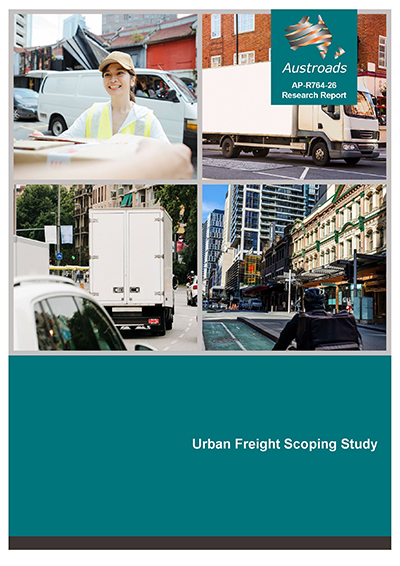
- Publication no: AP-R764-26
- ISBN: 978-1-923617-57-5
- Published: 1 July 2026
- PDF (free) Download
The purpose of this report is to provide an evidence-based overview of the urban freight task in Australia and New Zealand to support future policy development and decision-making.
The methodology for this research involved a literature review and consultation with 56 stakeholders from 30 organisations to examine trends, challenges and role of government in urban freight, as well as identify data gaps.
The study found that urban freight demand is increasing and becoming more complex, while planning, data availability and policy responses remain inconsistent across Australia and New Zealand. Several opportunities for road managers to better support the movement of urban freight are identified, including: improving awareness and capability across government planners and decision-makers, undertaking a number of targeted trials to help address existing industry pain points, and using collaborative forums to support problem-specific data sharing between government and industry. This research also presents an Urban Freight Evaluation Framework to assist policy makers to identify and collect data on different aspects of the urban freight task needed to answer specific targeted questions.
The findings of this study are intended to support road managers, transport agencies, planners and policymakers by providing a common evidence base, highlighting priority issues, and identifying areas where further investigation, trials or specific actions may be warranted.
Join the webinar
Wednesday, 26 August 2026, 1:00 – 2:00pm AEST| Presented by Phil Bullock, Lachlan Benson and Evelyn Bratchford.
No charge but registration is essential. Can't make the live session? Register and we'll send you a link to the recording.
- Summary
- 1. Introduction
- 1.1 Background
- 1.2 Purpose of the Urban Freight Scoping Study
- 1.3 Scope and focus
- 1.4 Methodology
- 1.5 Structure of this report
- 2. Literature Review
- 2.1 Key insights
- 2.2 Definitions of urban freight
- 2.2.1 The link between urban freight and the ‘last mile’
- 2.2.2 Urban freight flows
- 2.3 The growing urban freight task
- 2.3.1 Estimating the scale of the freight task
- 2.3.2 Key drivers of urban freight growth and change
- 2.3.3 Economic value
- 2.4 Challenges for urban freight activity
- 2.5 The costs of urban freight
- 2.6 How do governments influence the movement of urban freight
- 2.7 Increasing urban freight productivity and sustainability
- 2.7.1 Industry actions
- 2.7.2 Government actions
- 2.7.3 Barriers to the adoption of more sustainable practices
- 3. Findings from Stakeholder Engagement
- 3.1 Key insights
- 3.2 Purpose of the engagement
- 3.3 Consultation process
- 3.4 Key findings from consultation
- 3.4.1 Changing freight task
- 3.4.2 Challenges
- 3.4.3 Data and measuring the urban freight task
- 3.4.4 Role of government
- 3.4.5 Existing support for policy makers
- 3.4.6 Opportunities to improve the movement of freight
- 4. Measuring and Evaluating Urban Freight
- 4.1 Background
- 4.2 Urban Freight Evaluation Framework
- 4.2.1 Demand
- 4.2.2 Productivity
- 4.2.3 Network performance
- 4.2.4 Land use capacity
- 4.2.5 Externalities
- 4.3 Guide to key actions
- 4.4 Resources
- 4.4.1 Guidance and decision-making tools
- 4.4.2 Data sources
- 4.4.3 Trials
- 5. Findings and Recommendations
- 5.1 Findings
- 5.1.1 Lack of planning for urban freight
- 5.1.2 Impacts on industry
- 5.1.3 Urban freight data sharing
- 5.2 Recommendations
- 5.1 Findings
- References