
Pavement
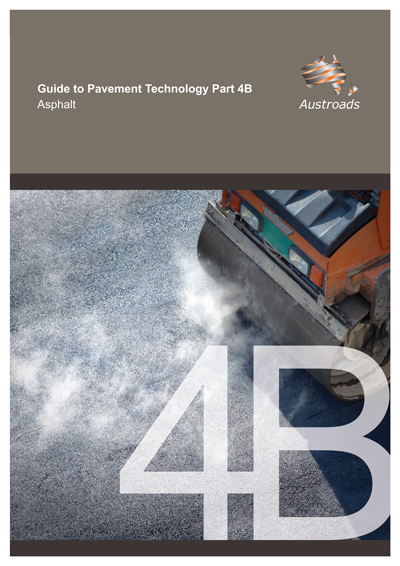
- Publication no: AGPT04B-14
- ISBN: 978-1-925037-67-8
- Published: 6 June 2014
- Edition: 2
- Superseded
- PDF (free) Download
The Guide to Pavement Technology Part 4B: Asphalt provides an introduction to the nature of asphalt as a material and its application in road pavements.
Asphalt is widely used in the construction and surfacing of roads in Australasia. The properties of asphalt are complex and its performance requirements vary considerably with the application. Engineers designing works incorporating asphalt need to understand its properties, appropriate use, application specifications and construction requirements.
Other parts of the Guide to Pavement Technology provide supporting detail for placing asphalt and the selection of materials for particular applications.
Edition 2.0 of the Guide includes major structural changes and the outcomes of a thorough review of asphalt mix designs and design methods.
- 1. Introduction
- 1.1 General
- 1.2 Asphalt Mix Types
- 1.3 Manufacture and Placing
- 1.4 Sustainability
- 2. Asphalt Applications and Mix Types
- 2.1 Applications
- 2.2 Design of New Pavements
- 2.3 Structural Performance of Asphalt
- 2.4 Rehabilitation
- 2.4.1 General
- 2.4.2 Treatment Types
- 2.5 Operational Environment Factors
- 2.6 Types of Asphalt Mixes
- 2.6.1 General
- 2.6.2 Dense Graded Asphalt (DGA)
- 2.6.3 Stone Mastic Asphalt (SMA)
- 2.6.4 Open Graded Asphalt (OGA)
- 2.6.5 Fine Gap Graded Asphalt (FGGA)
- 2.7 Asphalt Courses
- 2.7.1 General
- 2.7.2 Wearing or Surface Course
- 2.7.3 Intermediate Course
- 2.7.4 Basecourse
- 2.7.5 Regulating, Levelling or Corrective Course
- 2.7.6 Deep Strength and Full Depth Asphalt
- 2.8 Mix Size and Layer Thickness
- 2.8.1 Nominal Mix Size
- 2.8.2 Layer Thickness
- 2.8.3 Ultra-thin Asphalt Surfacing (UTA)
- 2.9 Warm Mix Asphalt
- 3. Materials
- 3.1 Introduction
- 3.2 Aggregates
- 3.2.1 Sources of Aggregate
- 3.2.2 Aggregate Properties
- 3.2.3 Reclaimed Asphalt Pavement
- 3.2.4 Other Recycled Materials
- 3.3 Filler
- 3.4 Binders
- 3.4.1 Bitumen
- 3.4.2 Multigrade Bitumen
- 3.4.3 Polymer Modified Binder
- 3.4.4 Epoxy Modified Bitumen and Polyurethane Materials
- 3.4.5 Cutback Bitumen
- 3.4.6 Bituminous Emulsion
- 3.5 Additives
- 3.5.1 General
- 3.5.2 Adhesion Agents
- 3.5.3 Bitumen Flow Modifiers
- 3.5.4 Fibres
- 3.5.5 Natural Modifiers
- 3.5.6 Rejuvenating Agents
- 3.5.7 Coloured Pigments
- 4. Mix Design
- 4.1 Introduction
- 4.1.1 General
- 4.2 Design Process
- 4.2.1 Background
- 4.2.2 Selection of Mix Type and Component Materials
- 4.2.3 Recipe Criteria
- 4.2.4 Preparation and Compaction of Trial Mixes
- 4.2.5 Volumetric Properties
- 4.2.6 Mechanical Testing
- 4.2.7 Workability
- 4.2.8 Job Mix
- 4.2.9 Implementation and Verification of Mix Properties
- 4.3 Volumetric Properties
- 4.3.1 General
- 4.3.2 Determining Density of Components
- 4.3.3 Bulk Density of Asphalt
- 4.3.4 Maximum Density
- 4.3.5 Voids in Mineral Aggregate (VMA)
- 4.3.6 Air Voids
- 4.3.7 Binder Content
- 4.3.8 Voids Filled with Binder (VFB)
- 4.3.9 Binder Film Index
- 4.4 Mechanical Testing
- 4.4.1 General
- 4.4.2 Resilient Modulus
- 4.4.3 Wheel Tracking
- 4.4.4 Moisture Sensitivity (Stripping Potential)
- 4.4.5 Fatigue
- 4.4.6 Marshall Stability and Flow
- 4.5 Combining Component Materials
- 4.5.1 Selecting a Target Grading
- 4.5.2 Maximising Packing Properties of Dense Graded Mixes
- 4.5.3 Combining Aggregates to a Target Grading
- 4.6 Laboratory Mixing and Compaction of Asphalt Mixes
- 4.6.1 Sample Preparation and Conditioning
- 4.6.2 Compaction
- 4.6.3 Gyratory Compaction
- 4.6.4 Marshall Compaction
- 4.7 Mix Design Procedure for Dense Graded Mixes
- 4.7.1 General
- 4.7.2 Improving Mix Performance
- 4.7.3 Warm Mix Asphalt
- 4.7.4 Polymer Modified Binders
- 4.7.5 Crumb Rubber Asphalt Mixes
- 4.7.6 Reclaimed Asphalt Pavement (RAP)
- 4.7.7 Cold Mix
- 4.8 Stone Mastic Asphalt (SMA)
- 4.8.1 Characteristics of SMA
- 4.8.2 Design Procedure
- 4.8.3 Design Requirements
- 4.8.4 Aggregates
- 4.8.5 Fillers and Binders
- 4.8.6 Sample Preparation
- 4.8.7 Binder Drain-off
- 4.8.8 Measurement of Bulk Density
- 4.9 Open Graded Asphalt (OGA)
- 4.9.1 Characteristics of OGA
- 4.9.2 Design Procedure
- 4.9.3 Design Requirements
- 4.10 Fine Gap Graded Asphalt (FGGA)
- 4.1 Introduction
- 5. Asphalt Manufacture
- 5.1 Introduction
- 5.2 Types of Mixing Plants
- 5.2.1 General
- 5.2.2 Sites for Mixing Plants
- 5.3 Raw Material Supply and Storage
- 5.3.1 Aggregate Supply
- 5.3.2 Aggregate Stockpiles
- 5.3.3 Stockpiling and Handling of RAP
- 5.3.4 Mineral Filler Storage
- 5.3.5 Binder Storage
- 5.3.6 Storage of Additives
- 5.4 Batch Mixing Process
- 5.4.1 General
- 5.4.2 Cold Aggregate Bins
- 5.4.3 Cold Aggregate Feeding
- 5.4.4 Aggregate Heating and Drying
- 5.4.5 Dust Extraction
- 5.4.6 Screening of Hot Aggregates
- 5.4.7 Hot Aggregate Bins
- 5.4.8 Filler Feeding
- 5.4.9 Aggregate Proportioning
- 5.4.10 Binder Proportioning
- 5.4.11 Mixing
- 5.4.12 Controls
- 5.4.13 Reclaimed Asphalt Pavement (RAP)
- 5.5 Continuous Mixing Plants
- 5.5.1 General
- 5.5.2 Parallel Flow Drum Mixer
- 5.5.3 Counterflow Drum Mixer
- 5.5.4 Drum within a Drum (Double Drum Mixer)
- 5.5.5 Tandem Drum Mixers
- 5.5.6 Cold Mixing Plant
- 5.6 Warm Mix Asphalt
- 5.7 Asphalt Surge and Storage Bins
- 5.8 Cold Mix
- 5.9 Cold Recycling of Asphalt and Bituminous Stabilisation
- 5.10 Routine Inspections
- 6. Asphalt Paving
- 6.1 General
- 6.2 Planning
- 6.3 Surface Preparation
- 6.3.1 Cleaning
- 6.3.2 Correction of Defects
- 6.3.3 Tack Coating
- 6.4 Transport
- 6.5 Spreading
- 6.5.1 General
- 6.5.2 Material Transfer Vehicle
- 6.5.3 Spreading by Asphalt Paver
- 6.5.4 Joints
- 6.6 Compaction
- 6.6.1 General
- 6.6.2 Compaction Equipment
- 6.7 Finished Surface Properties
- 7. Quality of Asphalt
- 7.1 General
- 7.2 Control and Monitoring of Asphalt Manufacture
- 7.2.1 Tests on Raw Materials
- 7.2.2 Production Process
- 7.2.3 Sampling and Testing
- 7.2.4 Statistical Process Control
- 7.3 Checklists
- References
- Appendix A Testing of Components
- A.1 Introduction
- A.2 Aggregates
- A.3 Fillers
- A.4 Binders
- A.4.1 Bitumen
- A.4.2 Modified Binders
- Appendix B Mixing, Conditioning and Compaction of Samples for Density Testing
- B.1 General
- B.2 Prior to Mixing
- B.3 Mixing
- B.3.1 General
- B.3.2 Raw Materials
- B.3.3 Pre-mixing and Material Preparation
- B.3.4 Mixing of Binder and Aggregates
- B.4 Splitting of the Mix
- B.4.1 General
- B.4.2 Cone and Quartering
- B.4.3 Sample Divider
- B.5 Conditioning
- B.6 Compaction
- B.6.1 Principles of Gyratory Compaction
- B.6.2 Gyratory Compaction to a Set Density or to a Set Number of Gyratory Cycles
- Appendix C Measurement of Volumetric Properties
- C.1 Introduction
- C.2 Specimen Requirements
- C.3 Equipment
- C.4 Calculation of Volumetric Properties
- C.4.1 Bulk Density
- C.4.2 Maximum Density
- C.4.3 Voids and Density Relationships
- C.5 Interpretation of Results
- C.6 Effect of Variables on Volumetric Properties
- Appendix D Measurement of Modulus
- D.1 Introduction
- D.2 Specimen Requirements
- D.3 Equipment
- D.4 Monitoring of Test Temperature
- D.5 Load Duration
- D.6 Poisson’s Ratio
- D.7 Interpretation of Results
- D.8 Effect of Variables on Resilient Modulus
- Appendix E Wheel Tracking Test
- E.1 Introduction
- E.2 Specimen Requirements
- E.3 Equipment
- E.4 Test Procedure
- E.5 Monitoring of Test Temperature
- E.6 Specimen Examination
- E.7 Effect of Variables on the Tracking Rate
- E.8 Interpretation of Results
- Appendix F Measurement of Moisture Sensitivity
- F.1 General
- F.2 Specimen Requirement
- F.3 Equipment
- F.4 Standard Procedure
- F.5 Use of Additives
- Appendix G Measurement of Fatigue
- G.1 Introduction
- G.2 Developments in Measurement of the Fatigue of Asphalt Mixes
- G.3 Specimen Requirements
- G.4 Equipment
- G.5 Monitoring of Test Temperature
- G.6 Interpretation of Results
- G.7 Factors Affecting Fatigue Performance
- Appendix H Measurement of Particle Loss
- H.1 Introduction
- H.2 Specimen Requirements
- H.3 Equipment
- H.4 Monitoring of Test Temperature
- H.5 Interpretation of Results
- H.6 Effect of Variables on Particle Loss