
Tunnels
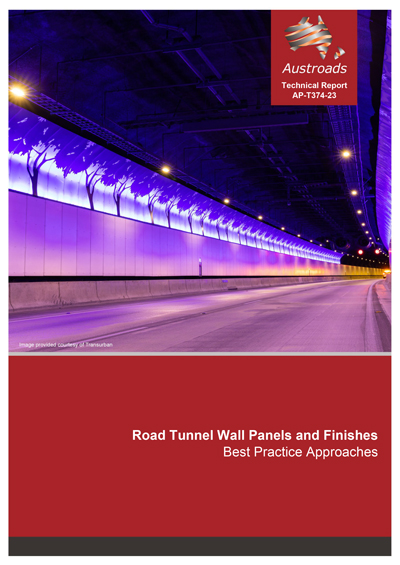
- Publication no: AP-T374-23
- ISBN: 978-1-922700-96-4
- Published: 21 April 2023
- PDF (free) Download
This report documents the best practice approaches for the use of road tunnel wall panels and finishes, which informed the development of a specification framework. This was developed through a workshop with subject-matter experts, review of current practice, stakeholder consultation and a review of literature.
Limited information was identified through the literature, with the stakeholders and design documentation largely informing the current design, operational and maintenance practice. The design practice review identified the requirements for a number of Australian and New Zealand road tunnels, which included the aesthetics, material, framing, design life and loading. The operations and maintenance practice review identified considerations to be incorporated in the design and the processes involved. These included the ability for wall panels to be removed and replaced, monitoring, access, human factors and cleaning.
Based on the findings, a framework for a specification was developed. This identifies the information which is required to select and install the appropriate panel and finish for road tunnel walls. The framework is suggested to be developed into an Austroads technical specification, with agreed requirements for materials and design parameters.
Watch a webinar with Tony Peglas and Georgia O’Connor for a detailed overview of the project and its findings.
- Summary
- 1. Introduction
- 1.1 Purpose
- 1.2 Scope and Approach
- 1.3 Structure of the Report
- 1.4 Methodology
- 1.4.1 Stakeholder Workshop
- 1.4.2 Current Practice Review
- 1.4.3 Stakeholder Consultation
- 1.4.4 Literature Review
- 1.4.5 Specification Framework
- 2. About Road Tunnel Wall Panels and Finishes
- 2.1 What are Road Tunnel Wall Panels and Finishes?
- 2.2 What are the Functions of Road Tunnel Wall Panels?
- 2.2.1 Lighting Reflectance
- 2.2.2 Road Safety and Aesthetics
- 2.2.3 Energy Improvements
- 2.2.4 Noise Reduction
- 2.2.5 Fire Resistance
- 2.2.6 Wayfinding
- 2.3 Planning for Road Tunnel Wall Panels
- 2.4 Performance Testing
- 2.4.1 Fatigue Testing
- 2.4.2 Current Design Practice
- 3. Specifications and Guidance Material
- 3.1 Tunnel Operations, Maintenance, Inspection, and Evaluation (TOMIE) Manual
- 3.2 Design Manual for Roads and Bridges
- 3.3 Guide to Road Tunnels Part 2: Planning, Design and Commissioning
- 3.4 Guide to Road Design Part 6: Roadside Design, Safety and Barriers
- 3.5 PIARC Road Tunnels Manual
- 3.5.1 Strategy and General Design
- 3.5.2 Equipment and Systems
- 3.5.3 Safety
- 3.5.4 Operation and Maintenance
- 3.6 Product Specification
- 4. Current Design Practice
- 4.1 Colour Schemes
- 4.2 Lighting Reflectance
- 4.3 Aesthetics and Arrangement
- 4.3.1 Height Above Pavement
- 4.3.2 Working Width Interface
- 4.4 Wall Finish Materials
- 4.4.1 Vitreous Enamel
- 4.4.2 Compressed Fibre Cement
- 4.4.3 Paint
- 4.5 Framing Options
- 4.5.1 Framing System Case Studies
- 4.5.2 Wall Panel Base Connection
- 4.6 Specified Design Life
- 4.7 Durability
- 4.8 Loads
- 4.9 Fire Resistance
- 5. Operations and Maintenance Practice
- 5.1 Wall Panel Removal and Replacement
- 5.2 Monitoring
- 5.3 Access to Tunnel Drainage
- 5.4 Human Factors
- 5.5 Cleaning
- 5.6 Routine and Periodic Inspections
- 5.7 Post-fire Inspections
- 6. Tunnel Wall Panel Case Studies
- 6.1 Wellington Tunnels
- 6.2 Sydney Harbour Tunnel
- 6.3 Mullum Mullum Tunnel, EastLink, Melbourne
- 6.4 Burnley Tunnel, CityLink, Melbourne
- 6.5 Graham Farmer Freeway Tunnel, Perth
- 6.6 Heysen Tunnel, Adelaide
- 6.7 Waterview Tunnel, Auckland
- 6.8 Johnstone’s Hill Tunnel, Puhoi, and Victoria Park Tunnel, Auckland
- 7. Specification Framework
- 8. Conclusions and Recommendations
- 8.1 Project Summary and Conclusions
- 8.2 Key Findings
- 8.3 Recommendations
- References
- Appendix A. Reviewed Design Documents
- A.1 Panel Height Above Pavement
- A.2 Wall Finishes
- A.3 Design Life
- A.4 Fire Resistance
- A.5 Tunnel Drainage
- Appendix B. Specification Framework