In this section
Background of Charting a Path to Zero Project
Problem, Vision, Objectives
Problem
Around 1,500 people lose their lives, and more than 42,000 others suffer serious injuries each year on the roads of Australia and New Zealand (2013-2024). At the same time, the road transport system is becoming more complex, with an ageing population, new vehicle technologies, rising levels of active travel and micromobility, a growing population, increasing motorised vehicles and exposure, and other emerging risks and opportunities. Traditional, incremental safety improvements are no longer sufficient to deliver the scale of trauma reduction needed.
Road trauma is not only a safety issue—it also shapes how people move and participate in society. Fear of crashes and injuries can discourage walking, cycling and micromobility use, particularly for children, older people and those with disabilities, limiting access to schools, jobs and community life. Safer streets can therefore deliver broader co-benefits for health, equity, environmental sustainability, and more liveable places.
Aligning with global best practice adopted by road safety–leading jurisdictions, national approaches in Australia and New Zealand commonly include:
- interim targets to substantially reduce deaths and serious injuries by 2030 (Australia’s current target is 50% fatalities and 30% serious injuries); and
- a longer-term aspiration to eliminate road deaths and serious injuries (often expressed as a 2050 horizon).
While some progress has been made in Australia and New Zealand, no Australian or New Zealand jurisdiction has ever experienced sustained trauma reductions at the scale required to achieve these targets by 2030 and 2050.
To reach these ambitious targets, governments need effective road safety planning: clear strategies and action plans, programs and investments that match the scale of the problem, and targets and safety performance indicators that drive sustained reductions in deaths and serious injuries over the coming decades.
Vision
Austroads has been at the forefront of developing guidance and evidence to support the implementation of life-saving road safety strategies, management systems, programs and initiatives.
The Charting a path to eliminating road death and serious injury project aimed to provide practical guidance to help advance the all-levels-of-government leadership needed to fully implement the actions required to reduce fatalities and serious injuries to zero by 2050. In doing so, the project also identified change-management activities and enabling actions (such as advocacy, promotion and training) needed to shift attitudes and build acceptance among professionals, institutions, the media, key stakeholders, and the community.
Objectives
The project provided extensive guidance and technical advice to road safety leaders, road managers, and practitioners involved in road design, vehicle registration, driver licensing and enforcement to:
- support Austroads members in charting their own sustainable path to Zero
- quantify the impacts of road trauma and benefits of eliminating serious road trauma
- identify actions local governments can take to facilitate the elimination of serious road trauma in their communities
- assist efforts to optimise future investment in road safety
- support stakeholders and other road transport program owners to align their objectives with safety goals.
Project Streams at a Glance
Project Streams
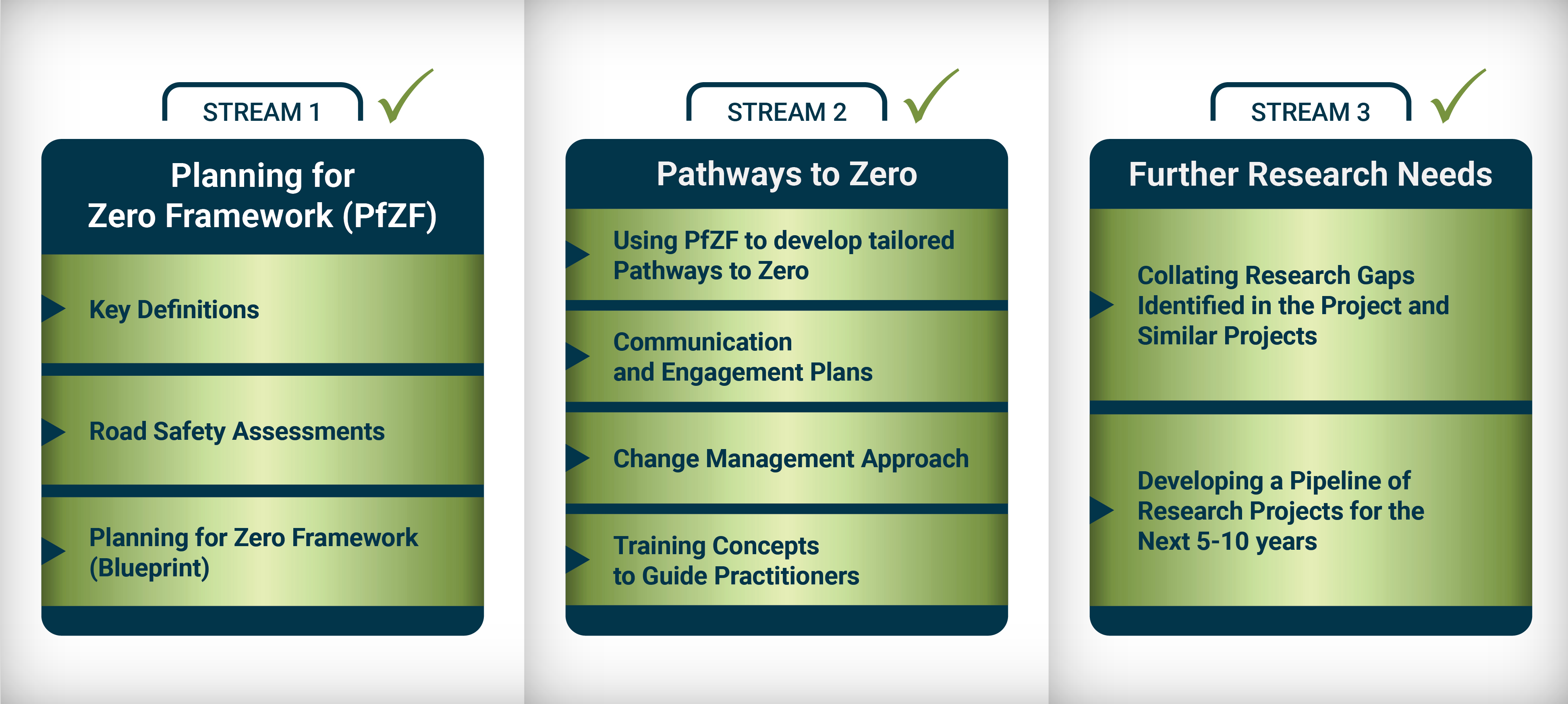
Austroads project SAG6365 Charting a Path to Eliminating Road Death and Serious Injury (Charting a Path to Zero) has three work streams:
- Stream 1: Zero Harm Definition and Current State Assessmentsfocuses on the Planning for Zero Framework, a blueprint for developing highly effective road safety strategies. The Framework defines the necessary steps to achieve a Safe System End State (SSES), provides benchmarking of systemic risks and safety gaps, and outlines a process for identifying enablers and blockers that will either help or hinder the required change. Stream 1 included a series of 11 recommendations necessary to support jurisdictions in achieving this transformational change.
- Stream 2: Developing Pathways to Zero and Comprehensive Support Materials provides guidance on preparing Pathways to Zero, demonstrating how the Framework and its recommendations can be adopted by Austroads members. It also outlines the communication, engagement, change management, and training support materials required for successful implementation.
- Stream 3: Identification of Knowledge Gaps and Research Needs identifies key road safety knowledge and research gaps that must be addressed to achieve Vision Zero outcomes in Australia and New Zealand.
Charting a Path to Zero Streams of Works