
Wednesday, 8 April 2026
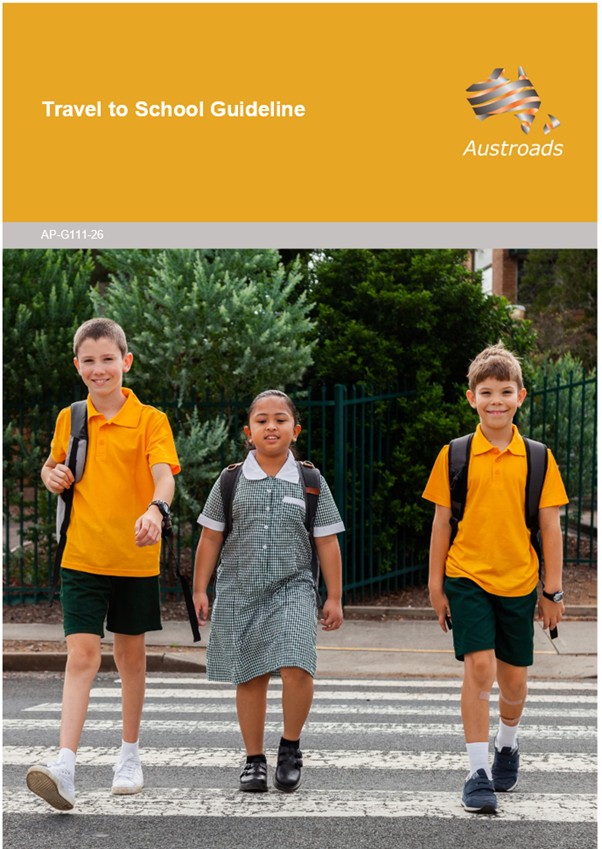
Austroads’ new Travel to School Guideline provides practical, evidence-based guidance to help road agencies, local government and school communities support safer travel to and from school.
Improving safe and active travel options for school students is better for the student, and better for the community. Research indicates that up to a quarter of morning-peak car trips are trips to school. Empowering more students to walk, cycle or use public transport is therefore not only better for their physical health and mental wellbeing, but also helps reduce congestion across the network. And, in times of fuel shortage, students using safe, active travel modes help relieve pressure on household budgets and fuel supplies.
The Austroads’ Travel to School Guideline sets out evidence-based approaches for prioritising children’s mobility, health and wellbeing across a wide range of school environments. It recognises the complexity of the challenges faced by schools, families, and those responsible for planning and managing transport networks, and provides practical options and tools to address them.
“Improving travel options for children on their way to and from school is a no-brainer, but it requires systems thinking and collaboration between students and caregivers, road managers, and schools,” said Amy Naulls, Austroads Transport Network Operations Program Manager. “This Guideline provides a practical framework that brings planners, engineers, schools and communities together to address local challenges and improve safety for some of the most vulnerable members of our community.”
The Guideline responds to increasing congestion and safety concerns around schools, as well as declining levels of physical activity among children. It emphasises the importance of considering the wider school precinct, rather than focusing solely on drop‑off and pick‑up areas immediately outside the school gates.
The Guideline is supported by two Austroads research reports that informed its development.
Travel to School: Principles Underpinning the Guidance establishes the evidence base and key principles for safe and active school travel, while Travel to School: Best Practice and Consultation Findings draws on stakeholder consultation and real‑world examples to identify effective approaches across different school contexts.
Drawing on this research, along with policy analysis, stakeholder engagement and case studies, the Guideline outlines good practice for both new and existing schools. It highlights how decisions about school siting, zoning and catchments, crossing facilities, neighbourhood design, street environments and end of trip facilities directly influence how children travel and how safe those journeys are.
Collaboration is a central theme of the guidance. The Guideline encourages school communities, local government, education authorities and transport agencies to work together to identify issues, prioritise actions and deliver solutions that respond to local context and needs.
To support this, the Guideline sets out a structured, community‑informed planning process to help identify barriers to safe travel, assess risks and implement targeted improvements. These may include infrastructure upgrades, speed management, behaviour‑change initiatives and parking strategies, all supported by monitoring and evaluation to inform ongoing improvement.
Amy Naulls said the work has particular significance. “My passion for improving safe travel to school began when my oldest child started primary school. Like many parents I discovered it was challenging to keep a busy prep student safe on our way to school. Over time, I’ve valued working alongside local government teams, dedicated teachers, and parent communities to improve local infrastructure and create a neighbourhood that helps the whole community be active every day”.
“This Guideline is intended to support that same collaboration between educators, local government and families, so that our transport networks work better for school children.”
The Guideline does not mandate specific treatments or solutions, recognising that school environments vary widely across urban, suburban, regional and rural contexts. Instead, it provides a flexible framework that different jurisdictions and stakeholders can apply over time to improve safety and support active travel to school.
Download the publications
- Travel to School Guideline
- Travel to School: Principles Underpinning the Guidance
- Travel to School: Best Practice and Consultation Findings
Join the webinar
Thursday, 30 April 2026 at 1:00 PM AEST | Presented by Liz Irvin, Talia Bradmore, Prue Oswin and Alice Woodruff. The session includes live Q&A.
No charge but registration is essential. Can't make the live session? Register and we'll send you a link to the recording.