
Network
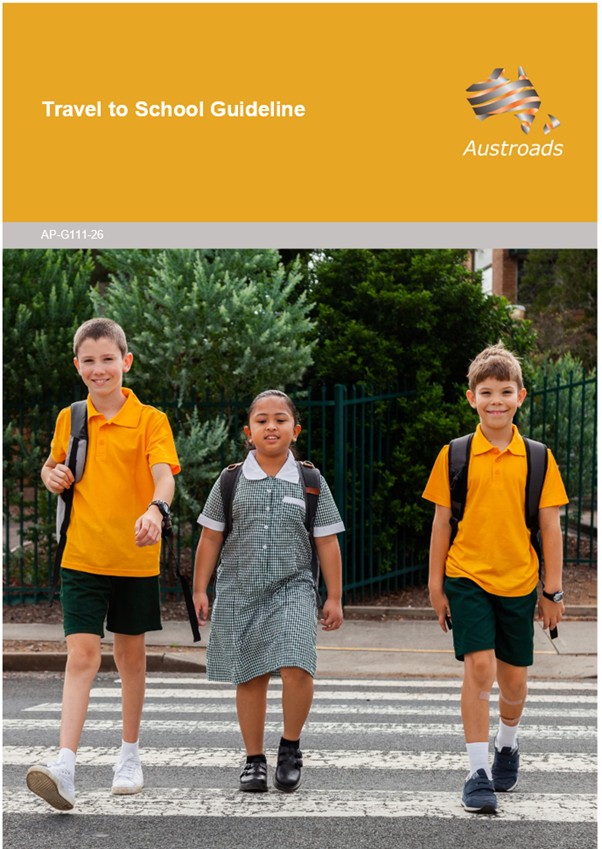
- Publication no: AP-G111-26
- ISBN: 978-1-923617-17-9
- Published: 17 March 2026
- PDF (free) Download
This Guideline has been developed to support the planning and delivery of safe and active travel to school. Its primary aim is to improve outcomes for students, parents and caregivers, school staff and communities by promoting integrated, evidence-based approaches that prioritise children's mobility, health, and safety within wider transport and land use planning systems.
The Guideline draws on a combination of research, policy analysis, stakeholder engagement, and case studies. It presents a structured planning framework that incorporates good practice principles and policy for the planning of new and existing schools. It references initiatives and practical tools to support implementation in various school environments.
Key takeaways from this Guideline are:
- Integrated planning is essential – land use, school siting, and transport infrastructure must be coordinated to avoid reinforcing unnecessary car-based travel.
- Collaboration across stakeholders, including the school community, local governments, and state and national agencies, is critical to success.
- A suite of integrated solutions is needed, combining infrastructure with travel behaviour change initiatives.
- A community informed transport planning process ensures local knowledge shapes effective, context-sensitive solutions.
The Guideline is designed to be adaptable across various school settings and includes tools for prioritisation, resource allocation, and ongoing monitoring to ensure continuous improvement.
Associated reports
The Guideline is the culmination of a set of other reports produced as part of the Austroads project NEG6441 Travel to School, including:
- Austroads’ research report Travel to School: Principles Underpinning the Guidance
- Austroads’ research report Travel to School: Best Practice and Consultation Findings.
These reports provide additional information relevant to this Guideline.
Webinar
Register for an upcoming webinar on 10 November 2026 with Alex Reid, Tracy Richards and Tara Watson about the Guideline in practice. Register now.
Watch a recording of the webinar on the Guideline to learn more.
- 1. Introduction
- 1.1 Purpose of the Guideline
- 1.2 Scope
- 1.3 Structure
- 1.4 Associated reports
- 1.5 Terms and definitions
- 2. Travel to School Context
- 2.1 Challenges
- 2.2 Connection to education
- 2.3 Benefits
- 2.4 Planning for children
- 2.5 School travel planning process
- 3. The Role of Integrated Planning in Shaping School Travel
- 3.1 Why integrated planning is important
- 3.2 A planning-led approach to safe and active travel at schools
- 3.2.1 Land use planning and sustainable mobility
- 3.2.2 Existing planning and delivery of new homes locking in car dependency
- 3.2.3 Built environment factors and travel to school
- 3.2.4 Planning principles for safe and active school travel
- 3.3 Movement and Place
- 3.4 Planning for different contexts
- 3.5 Planning for new schools
- 3.5.1 School catchment areas
- 3.5.2 School siting
- 3.5.3 School precinct transport assessment
- 3.5.4 School Transport Plan
- 4. Stakeholders and Collaboration
- 4.1 Stakeholders
- 4.1.1 School community
- 4.1.2 School staff
- 4.1.3 Local governments
- 4.1.4 National and state/territory education departments
- 4.1.5 National and state/territory government transport agencies
- 4.2 Roles and responsibilities
- 4.3 Working together
- 4.1 Stakeholders
- 5. Planning for Safe and Active Travel to School Through Integrated Solutions
- 5.1 Policy fundamentals
- 5.1.1 Safe System
- 5.1.2 Speed limits and school zones
- 5.2 Infrastructure fundamentals
- 5.3 Behaviour change fundamentals
- 5.4 Integrating infrastructure and behaviour change
- 5.5 Good practice transport solutions
- 5.5.1 Active transport
- 5.5.2 Public transport and school buses
- 5.5.3 Supporting behaviour change and education programs
- 5.5.4 Private vehicle management and parking
- 5.5.5 Streetscape enhancements
- 5.1 Policy fundamentals
- 6. Application: Community Informed Transport Planning Process
- 6.1 Community Informed Transport Plan
- 6.2 Engage users to identify barriers and opportunities
- 6.3 Investigate and assess risks
- 6.4 Identify and scope solutions
- 6.5 Implement and monitor solutions
- 7. List of Initiatives
- 8. Operations, Monitoring and Resources
- 8.1 Prioritising schools
- 8.2 Committing resources
- 8.2.1 People
- 8.2.2 Funding
- 8.3 Monitoring and evaluation
- 8.3.1 Overview
- 8.3.2 Making it happen
- 8.3.3 Reasons to collect data
- 8.3.4 How to monitor and evaluate
- References
- Appendix A Safe Routes to School
- Appendix B Intersection Guidance – Walk Wheel Cycle Trust
- B.1 Introduction
- B.1.1 Approach to planning for safe intersections
- B.1.2 Approaches to intersection design
- B.1.3 Good practice intersections
- B.1.4 Good practice crossings
- B.1.5 Roundabouts
- B.1 Introduction
- Appendix C Park and Walk
- C.1 What is the scheme and who is it suitable for?
- C.2 Why set it up?
- C.2.1 Setting up a Park and Walk scheme at your school
- C.2.2 Ideas for promoting it
- C.2.3 Monitoring
- Appendix D How to Select School Streets Programs – Case Studies (UK)
- D.1 London Borough of Camden Healthy School Streets initial report – school selection