
Network
- Publication no: AP-R751-26
- ISBN: 978-1-923617-18-6
- Published: 17 March 2026
- PDF (free) Download
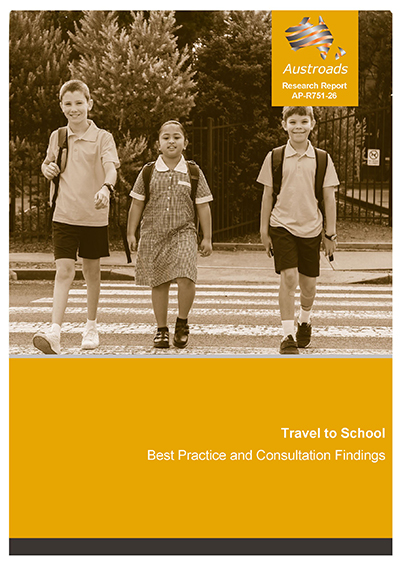
The purpose of this research report is to identify best practice insights from local and state government road manager operations, and other practitioners, to enhance safe active travel around schools, improve vehicle access management, and guide collaboration across agencies in planning new schools.
The methodology involved targeted workshops and interviews with government and non-government stakeholders engaged in travel to school projects across Australia and New Zealand. This approach facilitated the sharing of diverse experiences and perspectives, leading to a comprehensive understanding of stakeholder needs, challenges and successful case studies.
Key findings indicate that successful travel to school projects require a holistic approach that combines infrastructure improvements with behaviour change interventions. The report highlights critical focus areas for existing schools, such as vehicle conflicts, traffic congestion, and safe route deficiencies, and emphasises the need for early transport planning in the development of new schools.
This report provides a foundational understanding of best practice principles for school travel planning, highlighting the importance of collaboration among road managers, local governments, education agencies, and school communities. This report contributes to the work of prioritising community needs and adopting feasible, sustainable interventions for the purposes of creating safer and more accessible school travel environments.
The Guideline and the complementary report
The report summarises the stakeholder requirements for the Austroads Travel to School Guideline (AP-G111-26), which provides evidence-based guidelines for Austroads member agencies and partner organisations to support the planning and delivery of safe and active travel to school.
This report is also complementary to the Austroads’ research report Travel to School: Principles Underpinning the Guidance (AP-R750-26).
Webinar
Watch a recording of the webinar to learn more.
- 1. Introduction
- 1.1 Purpose
- 1.2 Scope
- 1.2.1 Context
- 1.3 Methodology
- 1.3.1 Workshop and interview overview
- 1.3.2 Workshop and interview approach
- 1.4 Report structure
- 2. Identifying Best Practice Insights
- 2.1 Overcoming challenges in existing schools
- 2.1.1 Transport infrastructure around schools
- 2.1.2 Road safety education and behaviour change interventions at schools
- 2.1.3 Integrating infrastructure delivery and behaviour change interventions
- 2.2 Identifying best practice insights into collaboration across agencies in planning for new schools
- 2.2.1 Consideration 1: Collaboration in site selection
- 2.2.2 Consideration 2: Collaboration in identifying transport needs
- 2.1 Overcoming challenges in existing schools
- 3. Stakeholder Requirements for the Guideline
- 3.1 Requirements summary
- 3.2 Stakeholder responses
- 3.3 Additional factors to consider
- 4. Defining Best Practice
- 4.1 Existing schools
- 4.1.1 Objectives for interventions to enable active transport to school
- 4.1.2 Typical types of projects
- 4.1.3 Developing a planning process
- 4.2 New schools
- 4.2.1 Principles for transport infrastructure around schools
- 4.2.2 Working definition of a safe route to school
- 4.1 Existing schools
- 5. Conclusion
- References
- Appendix A Case studies from Australia and New Zealand
- A.1 Parkdale Primary School (VIC)
- A.1.1 Context
- A.1.2 Issue(s)
- A.1.3 Intervention(s)
- A.1.4 Outcome(s)
- A.2 Lyall Bay School (NZ)
- A.2.1 Context
- A.2.2 Issue(s)
- A.2.3 Intervention(s)
- A.2.4 Outcome(s)
- A.2.5 Next steps
- A.3 Brunswick North West Primary School (VIC)
- A.3.1 Context
- A.3.2 Issue(s)
- A.3.3 Intervention(s)
- A.3.4 Outcome(s)
- A.3.5 Next steps
- A.4 Talara Primary College (QLD)
- A.4.1 Context
- A.4.2 Issue(s)
- A.4.3 Intervention(s)
- A.4.4 Outcome(s)
- A.4.5 Next steps
- A.5 Willoughby Public School (NSW)
- A.5.1 Context
- A.5.2 Issue(s)
- A.5.3 Intervention(s)
- A.5.4 Outcome(s)
- A.5.5 Next steps
- A.6 Waimataitai School (NZ)
- A.6.1 Context
- A.6.2 Issue(s)
- A.6.3 Intervention(s)
- A.6.4 Outcome(s)
- A.6.5 Next steps
- A.7 Woodend Primary School (SA)
- A.7.1 Context
- A.7.2 Issue(s)
- A.7.3 Intervention(s)
- A.7.4 Outcome(s)
- A.7.5 Next steps
- A.8 Riverton Primary Campus (WA)
- A.8.1 Context
- A.8.2 Issue(s)
- A.8.3 Intervention(s)
- A.8.4 Outcome(s)
- A.8.5 Next steps
- A.9 Galungara Public School (NSW)
- A.9.1 Context
- A.9.2 Issue(s)
- A.9.3 Intervention(s)
- A.9.4 Outcome(s)
- A.10 Sherwood State School (QLD)
- A.10.1 Context
- A.10.2 Issue(s)
- A.10.3 Intervention(s)
- A.10.4 Outcome(s)
- A.11 School Connectivity Improvements Project – City of Canning (WA)
- A.11.1 Context
- A.11.2 Issue(s)
- A.11.3 Intervention(s)
- A.11.4 Outcome(s)
- A.1 Parkdale Primary School (VIC)
- Appendix B International Case Studies
- B.1 Paris School Streets Program (France)
- B.1.1 Context
- B.1.2 Issue(s)
- B.1.3 Intervention(s)
- B.1.4 Outcome(s)
- B.1.5 Next steps
- B.2 Robert Blair Primary School – Islington School Streets Program (United Kingdom)
- B.2.1 Context
- B.2.2 Issue(s)
- B.2.3 Intervention(s)
- B.2.4 Outcome(s)
- B.1 Paris School Streets Program (France)