
Road Safety
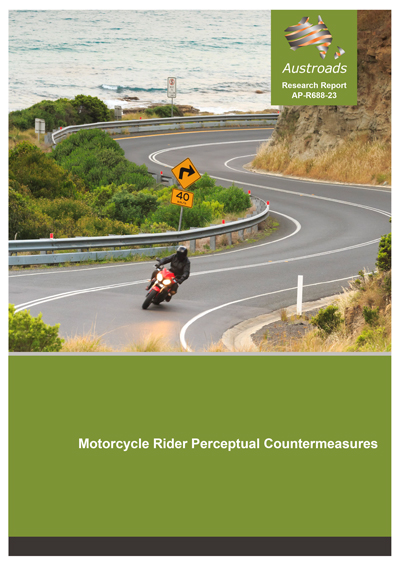
- Publication no: AP-R688-23
- ISBN: 978-1-922700-93-3
- Published: 18 April 2023
- PDF (free) Download
This report details a trial conducted to evaluate whether a suitable road-based perceptual countermeasure (PCM) could influence the travelling speed as well as lane position of motorcyclists to induce a safe curve negotiation. The motorcyclist PCM selected for the trial was a modified version of a peripheral transverse line marking with incrementally wider painted blocks through the curve apex. The PCM was trialled at two curves characterised by either high or low curvature along a popular route amongst motorcyclists with a known crash history. Two additional curves on the same route were used as control locations. Only the travel lane with right-hand curvature was treated and evaluated since the PCM design specifically aims to reduce intentional centreline crossing due to cutting through the curve chord. At each site, travel speed was measured at the curve apex and motorcycle lane position at both the entry and the apex of the curve.
A larger proportion of motorcyclists tended to position further away from the centreline compared to before the treatment. Motorcycle travel speed at the apex of both treated curves tended to decrease. Moderate reduction in travel speed at the apex of the treated curves was also observed for light and heavy vehicles. The trialled PCM design has high potential to enhance motorcyclist safety at critical curves along regional and rural routes and is compatible with various pillars of the safe system approach to road safety. Nonetheless, additional research is required to confirm the long-term effects observed in this trial as well as to investigate potential additional benefits or side effects. High-friction paint or thermoplastic film is suggested for future implementations.
Watch a webinar with Dr Mario Mongiardini and Dr Tana Tan for a detailed overview of the project and its findings.
- Summary
- 1. Introduction
- 2. Literature Review
- 2.1 Motorcycle User Groups and Risks
- 2.1.1 Introduction to Motorcycle Types
- 2.1.2 Motorcycle Types Mostly Involved in Crashes
- 2.1.3 Speed and Risky Behaviour
- 2.2 Engineering Countermeasures for Motorcycle Crashes
- 2.2.1 Introduction
- 2.2.2 The Characteristics of Motorcycles
- 2.2.3 Engineering for Motorcycles
- 2.3 PCMs to Reduce Travel Speed and/or Correct Lane Position
- 2.3.1 Post-mounted Delineators
- 2.3.2 Rumble Strips
- 2.3.3 Transverse and Herringbone Line Markings
- 2.3.4 Peripheral Transverse Lines
- 2.3.5 Warning Signs and Line Markings
- 2.3.6 Low Visual Contrast Edge Lines
- 2.3.7 Hatched Edge Lines
- 2.3.8 Painted Chequered Edge Lines
- 2.3.9 Hatched Centre Lines
- 2.3.10 Edge Lines and Reflector Guide Posts
- 2.3.11 Perceptual Lane Width Narrowing
- 2.3.12 Peripheral Transverse Line and Reflector Guide Posts
- 2.3.13 3D Road Markings
- 2.3.14 Where You Look Is Where You Go (WYLIWYG)
- 2.3.15 PCMs to Reduce Crash Risks in Tunnels
- 2.4 Conclusions
- 2.5 Additional Motorcyclist-focused PCM Evaluations (Identified After the Trial Commenced)
- 2.5.1 Peripheral Line Marking Treatment Trialled in Victoria
- 2.5.2 Gating Line Marking Treatment Trialled in Scotland
- 2.5.3 Peripheral Line Marking Treatments Trialled in Austria
- 2.1 Motorcycle User Groups and Risks
- 3. Design of the Perceptual Treatment
- 3.1 Identification of Suitable Perceptual Designs
- 3.2 Shortlisted Draft Designs
- 3.3 Selected PCM Design
- 4. Trial of the Perceptual Treatment
- 4.1 Analysis Approach
- 4.2 Trial Sites
- 4.2.1 Site Selection Process
- 4.2.2 Selected Sites
- 4.3 Data Collection
- 4.3.1 Collection Periods
- 4.3.2 Measurements
- 4.3.3 Analysed Periods
- 4.4 Implemented PCM
- 5. Results
- 5.1 Vehicle detections
- 5.2 Speed
- 5.2.1 Distribution
- 5.2.2 Descriptive Statistics
- 5.2.3 Cumulative Distribution
- 5.3 Lane Position
- 5.3.1 Distribution
- 5.3.2 Cumulative Distribution
- 5.4 Speed and Lane Position Relationship at the Curve Apex
- 6. Discussion
- 6.1 Observed Effects of the PCM Treatment
- 6.1.1 Influence of the PCM on Travel Speed
- 6.1.2 Influence of the PCM on Lane Position
- 6.2 Further Considerations Regarding the Trialled PCM Treatment
- 6.2.1 Potential Bias Due to Presence of Cameras and Radars
- 6.2.2 Treatment Effect on the Motorcyclist Trajectory
- 6.2.3 Long-term Effect of the Treatment
- 6.2.4 Treatment Effectiveness at Night-time
- 6.2.5 Potential Effect of a Media Release Ahead of the Post-treatment Evaluation
- 6.2.6 Potential Seasonal Effect
- 6.2.7 Additional Potential Benefits (Not Investigated in this Trial)
- 6.2.8 Potential Side Effects
- 6.2.9 Concerns Raised During the Trial
- 6.2.10 Expected Safety Outcomes of the PCM
- 6.2.11 Localised Installation of the PCM Treatment
- 6.2.12 Compatibility with the Safe System Approach to Road Safety
- 6.1 Observed Effects of the PCM Treatment
- 7. Conclusions
- References
- Appendix A Options and Recommendations Report
- A.1 Introduction
- A.2 Treatment Selection
- A.3 Trial Location
- A.4 Site Selection
- A.5 Recommendations
- Appendix B Workshop with Stakeholders
- B.1 Workshop Summary
- B.2 Workshop Minutes
- B.3 Poster Slides (With Comments and Ranking on Treatments)
- Appendix C Candidate Curves for the Trial
- C.1 Site 1
- C.2 Site 2
- C.3 Site 3
- C.4 Site 4
- C.5 Site 5
- Appendix D Radar and Video Cameras
- D.1 Locations of Radars and Video Cameras
- D.1.1 Tight Curves
- D.1.2 Shallow Curves
- D.2 Video Cameras - Views and Reference Scale for Lane Position
- D.1 Locations of Radars and Video Cameras
- Appendix E Treatment Installation
- Appendix F Speeds of Light and Heavy Vehicles
- F.1 Light Vehicles
- F.2 Heavy Vehicles