
Change Management – Barriers & Enablers Snapshot
1. Purpose of this artefact
Work is still required to understand the technical pathways for each jurisdiction to achieve their targets. However, it is well recognised that the biggest hurdle to turning this into action is road safety management and change management — in particular, securing active stakeholder engagement, support and commitment to the journey.
Through a review of existing research, industry workshops and one-on-one interviews, it was possible to synthesise a list of key themes that the Australian and New Zealand practitioners see as institutional road safety management and governance barriers and enablers to achieving Vision Zero end states, and also to maximising trauma reductions in the interim. Some of the identified issues may not be in direct control of Austroads members and may require additional influencing and guiding activities from members.
The key components of the Safe System End States (SSES), i.e. Vehicle, Road and Speed, were used to identify these barriers and enablers.
2. Barriers and enablers to the implementation of safer vehicles and achieving the desired Safe System end state vehicle fleet
Governance and Accountability: Lack of determination of responsibility and accountability for safety implementation.
Political Challenges: Lack of political will, leadership, and susceptibility to changes in the political climate.
Community Awareness and Understanding: Insufficient understanding among the public of road safety risks and the effectiveness of road safety interventions.
Standards and Innovation: Low safety standards from the government and large commercial fleet managers, coupled with a lack of innovation.
Manufacturers' Practices: Manufacturers opting for optional safety features, not uniformly offering all available features, and potential technological limitations.
Fleet Dynamics: Challenges related to fleet turnover, extended vehicle lifespans, and changes in vehicle size for freight, including concerns about motorcycles in the system.
Supply Chain Limitations: Constraints in the supply of materials, parts (microprocessors, etc.), and entire vehicles.
Regulatory Hurdles: Slow process in changing Australian Design Rules (ADRs) and potential challenges in balancing safety versus equity in regulatory changes.
Emerging Trends: Unaccounted growth in micro-mobility modes, potential redundancy of some technologies, and the popularity of motorcycles.
Security Concerns: Threats from malicious actors, lack of uniform data/communications protocols, and the need for comprehensive safety features covering pedestrians, cyclists, and micro-mobility.
Economic Factors: Funding challenges, economic downturn, cost implications for consumers, and maintenance requirements of technology.
Infrastructure and Alterations: Necessity for heightened maintenance of signs and lines, after-market alterations, and subscription-based safety features.
Market Dynamics: Australia's small market reliance on others to drive change, a lag in the uptake of new vehicles, lack of incentives for purchase, and the prominence of the used car market.
Consumer Behaviour: Customers avoiding technology uptake due to trust issues or a preference for manual control, fear of hacking, and resistance against modern vehicle subscription systems.
Policy Advocacy and Standards: Foster bipartisan political commitment.Establish minimum policy requirements. Expedite Australian Design Rules (ADR) reviews.
Stakeholder Engagement: Engage manufacturers collaboratively. Stimulate public demand through awareness. Encourage large organisations to report on road safety.
Incentives and Disincentives: Institute incentives for scrapping old vehicles.Streamline pathways for upgrading existing vehicles.Provide subsidies for safety initiatives.Discourage second-hand purchases lacking safety features.Integrate risk-based insurance with safety features.
Comprehensive Implementation: Swiftly implement comprehensive safety measures.Directly implement limiting Intelligent Speed Assist (ISA) rather than advisory.Conduct local-level trials for practical insights.
Research and Evaluation: Transparently research the safety impact of improved fleet safety. Undertake in-depth trauma modelling, especially for Vulnerable Road Users (VRUs). Determine the required level of adoption for enhanced safety.
Regulatory Measures: Regulate the second-hand car market for safety compliance. Standardise safety features with a universal descriptor.
Communication and Education: Effectively communicate the benefits of safer vehicles. Foster consumer understanding of the impact of safer vehicles.
Holistic Integration: Leverage the Occupational Health and Safety Chain of Responsibility concept for collective safety.Integrate safety considerations into various vehicle areas and policies, including Electric Vehicles.
3. Barriers and enablers to the implementation of a safer infrastructure/speed mix, and achieving the desired Safe System end state for infrastructure and speed
Political & Governance Barriers: Lack of political will and governance challenges hindering path to zero.
Financial & Funding Hurdles: Funding issues, unattractiveness for investment, and budget constraints.
Knowledge Gaps & Professional Capacity: Lack of understanding among professionals, including designers and engineers.
Incentive Structure & Regulatory Challenges: Overreliance on self-identified incentives, absence of regulatory enforcement.
Speed Limit Change Opposition: Opposition from the public and resistance to speed limit reductions. Cumbersome requirements (process, communication/consultation and signage) for speed limit adjustments.
Utility Decision-Making Impact: Decisions by utility providers without considering road user safety.
Challenges in Mode Shift: Inadequate incentives for transitioning from private to public transport. Disjointed networks hindering active transport initiatives.
Standards Delay & Infrastructure Design Issues: Slow updates to safety standards, and infrastructure design lagging in safety.
Car-Centric Development Planning: Bias in planning standards towards car-centric development. Challenges in balancing costs, parking, cycling facilities, and road space.
Integration of Road Safety: Road safety initiatives and requirements are often treated as a checkbox exercise rather than being properly integrated into projects, programs, strategies, action plans, initiatives and policies.
Infrastructure Change Challenges: Impact on cultural heritage and environmental areas. Transition challenges from a large, unsafe road network legacy.
Strategic Guidance Gap: Lack of a comprehensive strategic Path to Zero guide.
Community Acceptance Barriers: Difficulties in gaining community acceptance of safety-oriented changes. Lingering blame-the-driver mentality and community understanding gaps.
Cultural Preferences & Fast Travel Expectations: Society favouring cars and expecting fast travel. Prioritisation of non-safety factors by the community.
Limited Community Desire for Safety: Lack of enthusiasm from some for making roads safer compared to other societal desires.
Government Policy Advocacy: Actively engaging with policymakers to influence the creation and amendment of policies that prioritise and enhance the path to zero measures. This involves collaboration with legislative bodies to ensure a conducive legal environment.
Economic Impact Awareness: Improving understanding of the full economic impacts of road trauma and road safety interventions. This includes recognising the substantial costs of death and serious injury across health, insurance, productivity and community wellbeing, while also addressing the tendency to overestimate the negative economic impacts of safety measures such as speed reductions.
Political Engagement: Elevating road safety to the forefront of political agendas and discussions. This theme emphasises the importance of fostering political will and commitment to enact meaningful changes and allocate resources to enhance road safety.
Advocacy Initiatives: Mobilising communities and organisations to actively advocate for road safety initiatives that align with the path to zero. This involves campaigns, community outreach, and initiatives aimed at increasing public awareness and engagement in advocating for safer road environments.
Safety-First Road Building: Prioritising safety considerations in all phases of road construction and maintenance projects. This theme highlights the need for road authorities to make safety the paramount objective, ensuring that infrastructure improvements inherently enhance safety.
National Default Speed Limits: Advocating for the establishment of standardised national speed limits that align with End States. This involves lobbying for an approach to speed limits to promote consistency and effectiveness in enhancing road safety nationwide.
Community Empowerment: Empowering communities disproportionately affected by road trauma (e.g. rural/remote communities). This theme emphasises initiatives aimed at understanding and addressing the unique challenges faced by specific communities, ensuring that interventions are tailored and effective.
Integration with Strategic Plans: Aligning road safety objectives with broader strategic plans in areas such as public health, climate change, and personal safety. This approach ensures that road safety becomes an integral component of overarching community development strategies.
KPIs for Reduced Road Trauma: Establishing Key Performance Indicators (KPIs) focused on reducing road trauma. This involves setting measurable goals and targets to track progress and hold relevant stakeholders accountable for achieving significant reductions in accidents and fatalities.
Local Champions for Road Safety: Cultivating and supporting individuals within Local Government Areas to champion road safety causes. This involves identifying and empowering advocates who can influence decision-makers and drive positive change within their communities.
Safe System Consideration: Encouraging decision-makers to incorporate Safe System principles into planning and decision-making processes. This theme highlights the importance of designing and managing road systems with the path to zero approach.
Network Safety Planning for Funding: Making the development of Network Safety Plans (aligned with the path to zero) a prerequisite for funding allocations. This ensures that funding is directed towards projects that have a comprehensive safety strategy, aligning with overarching safety goals.
Public Opinion Surveys: Conducting surveys to gauge public attitudes towards road safety interventions. This theme involves gathering insights to address misconceptions and tailoring communication strategies to align with public sentiments.
Recognition of Practitioner Excellence: Acknowledging and rewarding professionals who contribute significantly to road safety initiatives. This recognition serves to motivate and showcase the positive impact of dedicated practitioners in the field.
Irreversible Positive Changes: Implementing changes that bring about lasting and positive impacts on road safety. This involves adopting measures that are not easily undone, ensuring a sustained commitment to creating safer road environments.
Change Management – Change Management Approach and Techniques
The Triple-P Framework provided the foundation for the analysis of how the Planning for Zero Framework is currently being adopted and implemented in Australia and New Zealand. This framework examines and addresses gaps across three critical dimensions - Policy, Process, and Politics - to ensure a holistic approach to public policy and change management.
Impact of Political Dynamics Across Levels of Government: The analysis undertaken across Australian jurisdictions, New Zealand, and a sample of local government areas highlighted the potential for political factors at different levels of government to affect the success of Pathway to Zero initiatives. The local government review provided insight into how local political dynamics can influence implementation on the ground, while the broader jurisdictional assessment highlighted wider state, territory and national-level barriers and enablers. Together, these findings underscore the need for future change management plans to account for both system-level and localised political challenges.
Policy-Process-Politics Misalignment: The assessment of seven sampled jurisdictions revealed a disconnect between policy and process maturity and political buy-in:
- While most jurisdictions demonstrated a solid understanding of the policy and process dimensions of Pathway to Zero, they consistently reported low levels of political alignment, buy-in, and stakeholder engagement. This indicates a pressing need to strengthen both the political narrative and public support for the initiative before jurisdictions are likely to allocate the necessary resources to achieve the 2050 goals.
- The Pathway to Zero framework remains insufficiently integrated across government agencies, limiting its impact and reducing opportunities for cross-agency collaboration.
- Advocacy for funding and resources relies heavily on road safety practitioners, with limited overt support from agencies that stand to benefit from the program’s outcomes.
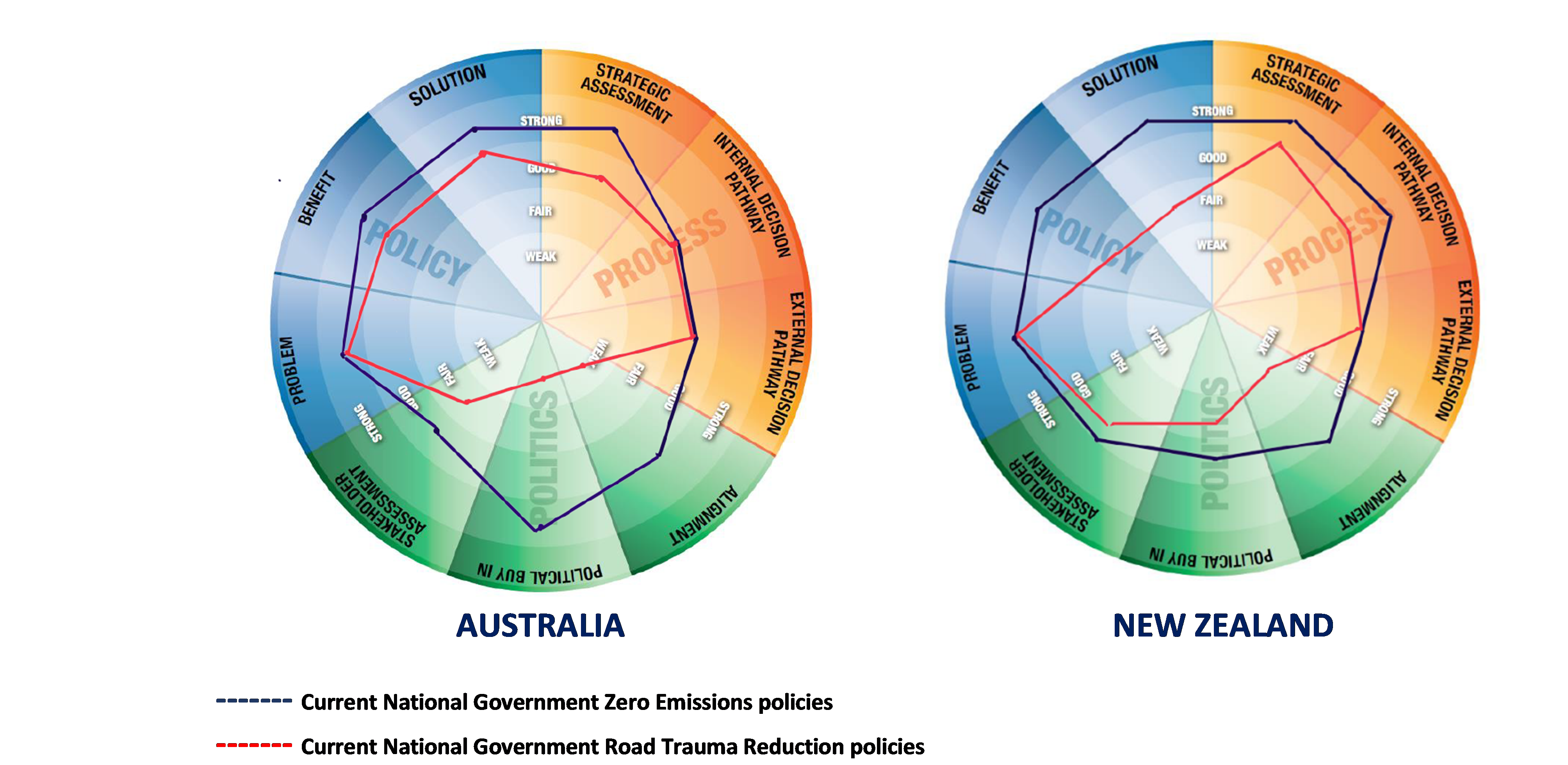
Comparative Political Commitment: To illustrate differences in political prioritisation, the analysis compared Zero Emissions policies and road trauma reduction policies across a set of change-management dimensions in the Triple-P Framework (see Figure 2.1). These dimensions reflect the relative strength of problem recognition, perceived benefits of action, clarity of solutions, strategic assessment, internal and external leadership, political buy-in, alignment, and stakeholder engagement.
The figure is intended to show that, in both Australia and New Zealand, road trauma reduction policies appear to have weaker political and organisational conditions for implementation than Zero Emissions policies across several of these dimensions. In particular, the comparison suggests that road safety has generally had less political buy-in, weaker cross-agency alignment, and less structural support, even where the problem itself is well understood. The comparison is illustrative rather than definitive, and is intended to highlight the broader challenge of political prioritisation rather than suggest that Zero Emissions policy is without its own limitations or implementation challenges.
Figure 2.1 Comparative Political Commitment (political commitment to Zero Emission policies and road trauma reduction policies)
Disconnect in Budgetary Beneficiaries: The budgetary beneficiaries of Pathway to Zero initiatives, such as the health sector, typically do not take a leading role in advocating for or financing these initiatives. For example, while a reduction in road trauma would significantly benefit public health systems, these agencies are often external to the processes of developing business cases and securing funding for Pathway to Zero programs. This disconnect limits the potential for broader financial and organisational support.
Economic Case for Pathway to Zero: Insights from a 2006 Victorian speed enforcement program review by the Victorian Auditor-General highlighted that the full economic cost of road trauma extends well beyond the care and compensation costs traditionally captured in economic models. This finding reinforces the importance of presenting a comprehensive economic assessment of the benefits of Pathway to Zero. Such an assessment should encompass:
- lost productivity
- environmental impacts
- road maintenance costs
- emergency management costs.
Framing the initiative in economic terms could provide a powerful financial incentive for government and community buy-in, bridging the gap in support and alignment.
These findings highlight critical barriers to the success of Pathway to Zero initiatives and offer valuable insights for addressing political, structural, and financial gaps in future road safety programs.
A series of actionable recommendations aimed at addressing the identified gaps in political buy-in, stakeholder alignment, and public awareness. These recommendations are designed to strengthen the Pathway to Zero road safety initiative by leveraging strategic engagement and leadership, financial framing, and robust narrative development.
Expand Engagement with Key Government Agencies
- Direct Engagement with Jurisdictions: The findings emphasise the need for more direct engagement with major jurisdictions to test hypotheses and refine strategies for reducing barriers to change.
- Inclusion of Non-Traditional Stakeholders: Recognising that the budgetary beneficiaries of Pathway to Zero initiatives often lie outside the traditional road safety domain, the findings stress the importance of involving these stakeholders.
- Securing Agency Endorsements: By broadening engagement, these agencies can be encouraged to endorse Pathway to Zero within their spheres of influence, thereby bolstering the initiative’s legitimacy and support.
Frame Pathway to Zero within a Compelling Financial Context
- Economic and Societal Benefits: The findings emphasise positioning Pathway to Zero in a financial context that resonates with multiple government agencies. This includes highlighting the economic benefits of reducing road trauma, such as improved productivity, reduced environmental impact, lower road maintenance costs, and decreased emergency management expenses.
- Independent Review by Productivity Commission: A specific recommendation involves leveraging the Productivity Commission to conduct an independent review. This would provide a comprehensive assessment of Pathway to Zero's economic impact, creating a persuasive financial incentive for governments and communities to support the full suite of reforms.
Strengthen Political and Public Narratives
- Economic and Community Benefit Narratives: The findings underscore the importance of developing and testing compelling narratives that resonate with decision-makers and the public. These narratives should clearly articulate the societal benefits of Pathway to Zero, emphasising its impact across various sectors.
Leverage Existing Tools for Self Assessment
- Proactive Evaluation: The findings encourage road safety practitioners to assess political alignment, buy-in, and leadership within their jurisdictions using existing tools:
- The Asian Development Bank's questionnaire was adapted to evaluate the maturity of Pathway to Zero systems at the jurisdictional level.
- A generic version of the Triple-P Framework, which can serve as a desktop exercise to identify improvement areas.
Adapt to the Evolving Political Landscape
- Political Sensitivity: The findings highlight the importance of adapting strategies to changing political contexts, priorities and election cycles over time.
- Proactive Engagement with New Governments: While early engagement with incoming governments is important, the findings suggest that stronger institutional embedment of Pathway to Zero is even more critical to reduce the impact of changing governments, shifting priorities and election cycles.
Build leadership capability and enhanced accountability
- Road Safety Leadership: Investing in road safety leadership capability will assist with building the trust necessary to engage a community-wide effort over decades to realise Vision Zero. Recognising that such an investment in leadership capability and public accountability to drive down road trauma will have a broader pay-off, building public trust in government agencies and thereby enhancing the effectiveness and efficiency of broader public policies and warrant public investment.
- Enhanced Accountability: All levels of government should more clearly define their road safety roles and responsibilities. Guiding and investing public resources should aid collaboration and help the community, stakeholders, and decision-makers to understand how the efforts complement and reinforce accountability. An annual forum or process to account for their respective performance annually and publicly against the published measures of progress along the Pathway to Zero.
These recommendations reflect a multifaceted and adaptable approach to societal and organisational change management for Pathway to Zero. By addressing barriers, shaping narratives, and building coalitions of support across government, industry, and the community, these strategies aim to drive sustainable progress toward eliminating road trauma by 2050.
