
Network
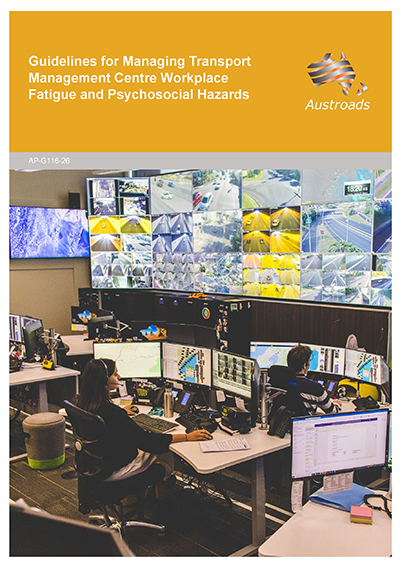
- Publication no: AP-G116-26
- ISBN: 978-1-923617-64-3
- Published: 24 July 2026
- PDF (free) Download
The purpose of these Guidelines is to provide Transport Management Centre (TMC) managers and Austroads member agencies with practical, evidence-based guidance on how to manage psychosocial and fatigue-related hazards. The Guidelines reflect an earlier research report and several rounds of consultation with TMC managers in both Australia and New Zealand.
Desktop and interview-based research was undertaken to identify current legal and compliance requirements, highlight best practice and apply what can be learnt from other sectors/industries facing similar challenges and/or operating contexts.
These Guidelines are intended for managers and leaders in organisations classified as a ‘person conducting a business or enterprise’ (PCBU) under workplace health and safety legislation.
The Guidelines should assist managers and leaders to understand, manage and monitor risk associated with fatigue and psychosocial risk. However, these Guidelines do not replace the requirement to consult with the workforce.
Download the report
The research report Managing Transport Management Centre Workplace Fatigue and Psychosocial Hazards (AP-R763-26) presents the current body of knowledge on fatigue management and psychosocial hazards in relation to the operating context of TMCs.
Watch the webinar recording
- 1. Introduction
- 1.1 Purpose
- 1.2 Background and context
- 1.3 Scope
- 1.4 Methodology
- 2. Managing Hazards in a Workplace Context
- 2.1 Fatigue hazards in the WHS context
- 2.2 Psychosocial hazards in the WHS context
- 2.3 Managing emergencies/crises in a workplace context
- 3. Fatigue
- 3.1 Introduction
- 3.2 What is fatigue?
- 3.3 What are the effects of fatigue?
- 4. What Causes Fatigue?
- 4.1 Time of day
- 4.2 Time on task
- 4.2.1 Rest
- 4.2.2 On-call
- 4.2.3 Economic incentives
- 4.3 Nature of task
- 4.4 Fitness for duty
- 4.5 Environment
- 5. Options for Controlling Fatigue
- 5.1 Fatigue management policies and procedures
- 5.2 Scheduling
- 5.3 Risk offset or counter-measures
- 5.4 Strategic napping
- 5.5 Lighting and ergonomics
- 5.6 Reasonable performance expectation
- 5.7 Promoting fitness for duty
- 5.8 Training and Information
- 5.9 Monitoring and reporting
- 6. Psychosocial Hazards
- 6.1 Introduction
- 6.2 What are psychosocial hazards?
- 6.3 What are the effects of psychosocial hazards?
- 7. What Causes Psychosocial Hazards?
- 7.1 Job demands
- 7.2 Traumatic events or material
- 7.3 Conflict or poor workplace relationships and interactions
- 7.4 Violence and aggression
- 7.5 Bullying
- 7.6 Poor support
- 7.7 Poor physical environment
- 7.8 Poor organisational justice
- 7.9 Lack of role clarity
- 7.10 Poor organisational change management
- 7.11 Inadequate reward or recognition
- 7.12 Remote or isolated work
- 7.13 Harassment including sexual harassment
- 8. Options for Managing Psychosocial Hazards
- 8.1 Leadership competencies
- 8.2 Targeted recruitment
- 8.3 Mental health literacy, education and support
- 8.4 Trauma management
- 8.4.1 Reducing exposure
- 8.4.2 Post-trauma intervention
- 8.5 Standardised Processes and Work Instructions
- 8.6 Performance management
- 8.7 Safe systems of work
- 8.8 Work demand equilibrium
- 8.9 Training and development
- 9. Absenteeism
- 9.1 Purpose
- 9.2 Defining absenteeism
- 9.3 Issues for consideration
- 10. Summary of Recommendations to Manage Fatigue and Psychosocial Hazards
- Appendix A Auckland Operations Centre ‘Hot Debrief’ Process
- References