
Network
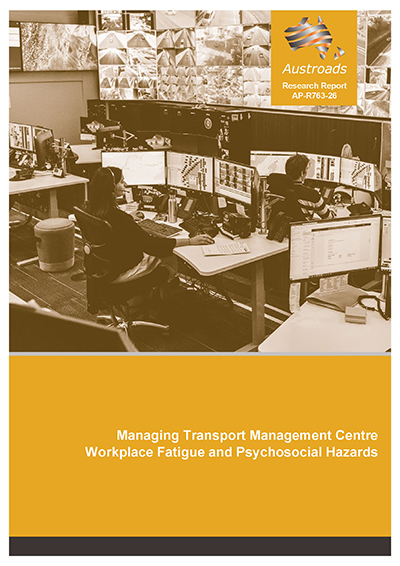
- Publication no: AP-R763-26
- ISBN: 978-1-923617-55-1
- Published: 24 July 2026
- PDF (free) Download
The purpose of this report is to provide guidance to Transport Management Centre (TMC) managers and Austroads member agencies on dealing with psychosocial and fatigue-related hazards. The central organising question of the project is: ‘How do TMCs keep staff safe and working at their optimal level where shift work and exposure to potentially traumatic incidents are inherent parts of the job?’
Desktop and interview-based research was undertaken to identify current legal and compliance requirements, highlight best practice, and apply lessons from other sectors and industries facing similar challenges or operating in comparable contexts.
The report makes specific recommendations on scheduling, policies and procedures, training and education, leadership, recruitment, and trauma management. It also proposes a definition of ‘absenteeism’ for adoption across TMCs.
Download the Guidelines
The Guidelines for Managing Transport Management Centre Workplace Fatigue and Psychosocial Hazards (AP-G116-26) provide a concise, practical summary of the good practice considered workable, feasible, and meaningful for TMCs.
Watch the webinar recording
- 1. Introduction
- 1.1 Purpose
- 1.2 Background and context
- 1.3 Scope
- 1.4 Methodology
- 1.5 Constraints, opportunities and risks
- 2. Transport Management Centres
- 2.1 Purpose and function
- 2.2 Workforce trends, issues, and challenges
- 2.2.1 Skills and qualifications
- 2.2.2 Attributes and competencies
- 3. What is Fatigue and Why is it a Hazard?
- 3.1 Introduction
- 3.2 What is fatigue?
- 3.3 What are the effects of fatigue?
- 4. What Causes Fatigue?
- 4.1 Time of day
- 4.2 Time-on-task
- 4.3 Nature of task
- 4.4 Fitness for duty
- 4.5 Environment
- 5. How Does the Law Deal with Fatigue?
- 5.1 Workplace health and safety law
- 5.2 Transport law
- 5.3 Emergency services law
- 6. Good Practice in Fatigue Management in a TMC Context
- 6.1 Fatigue management policies and procedures
- 6.2 Scheduling
- 6.3 Risk offset or counter-measures
- 6.4 Napping and downtime
- 6.5 Lighting and ergonomics
- 6.6 Reasonable performance expectation, especially during night shift
- 6.7 Fitness for duty
- 6.8 Training and education
- 6.9 Monitoring and reporting
- 7. What are Psychosocial Factors and Why are they a Hazard?
- 7.1 Introduction
- 7.2 What are psychosocial hazards?
- 7.3 What are the effects of psychosocial hazards?
- 8. What Causes Psychosocial Hazards?
- 8.1 Job demands
- 8.2 Traumatic events or material
- 8.3 Conflict or poor workplace relationships and interactions
- 8.4 Violence and aggression
- 8.5 Bullying
- 8.6 Poor support
- 8.7 Poor physical environment
- 8.8 Poor organisational justice
- 8.9 Lack of role clarity
- 8.10 Poor organisational change management
- 8.11 Inadequate reward or recognition
- 8.12 Remote or isolated work
- 8.13 Harassment, including sexual harassment
- 9. How Does the Law Deal with Psychosocial Hazards?
- 9.1 Australia
- 9.2 New Zealand
- 9.3 Tools and supports
- 10. Good Practice in Psychosocial Management in a TMC
- 10.1 Leadership
- 10.2 Targeted recruitment
- 10.3 Mental health literacy, education, and support
- 10.4 Trauma management
- 10.4.1 Reducing exposure
- 10.4.2 Post-trauma intervention
- 10.5 Standardised policies and procedures
- 10.6 Performance management
- 10.7 Safe systems of work
- 10.8 Work demand equilibrium
- 10.9 Training and development
- 11. What Can be Learned from Other Industries?
- 11.1 Emergency services
- 11.2 Rail
- 11.3 Road
- 11.4 Aviation
- 11.5 Maritime
- 12. Absenteeism
- 12.1 Purpose
- 12.2 Introduction
- 12.3 Defining absenteeism
- 12.4 The impact of absenteeism
- 12.5 Measuring absenteeism
- 12.6 How TMCs define absenteeism
- 12.7 What is presenteeism and how can it result in absenteeism?
- 12.8 Determining an appropriate definition for absenteeism
- 12.9 Issues for consideration
- 13. Conclusions and Recommendations
- 13.1 Fatigue
- 13.2 Psychosocial hazards
- References
- Appendix A Project Sub-Questions and Themes
- Appendix B Shift/Hours Comparative Table
- Appendix C Types of Rest and Principles
- Appendix D Fatigue Risk Assessment Examples
- D.1 Maritime
- D.2 Health
- D.3 Road
- Appendix E Police, Protective Services, and Security Services Example Control Measures
- Appendix F Rail Safety National Law National Regulations 2012-Reg 29