
Network
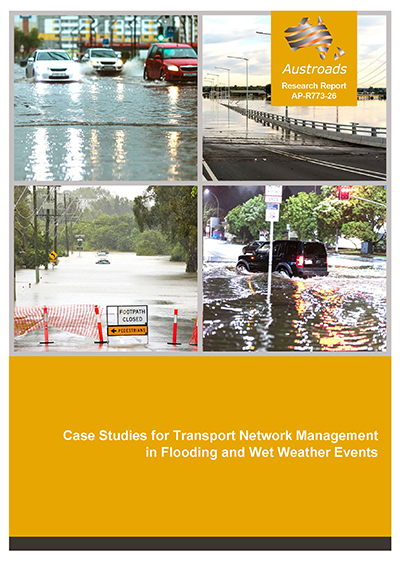
- Publication no: AP-R773-26
- ISBN: 978-1-923617-68-1
- Published: 4 September 2026
- PDF (free) Download
The purpose of this report is to inform the development of Austroads guidance for the management of flooding and wet weather events by transport agencies. By presenting case studies from Australia, New Zealand and other countries, this report will support transport agencies to better understand, manage, and adapt to flood-related risks across their road networks.
The case studies highlight practical applications of integrated, risk-informed approaches across planning, operations and recovery. Key components of transport network management guidance covered in the case studies include proactive planning, infrastructure resilience, climate adaptation, multimodal coordination, and data-driven decision making. They span a range of geographic contexts, agency types, and transport modes, offering insights into both immediate response and long-term adaptation.
The case studies highlight elements that are crucial to effective guidance, emphasising the value of local knowledge, early warning systems, community engagement, and cross-agency coordination. These real-world examples demonstrate how transport agencies can apply both established practices and innovative tools to improve flood preparedness and response. This report will be an important resource for road agencies seeking to improve decision-making, enhance emergency response capabilities, reduce disruption to transport networks, and strengthen long-term resilience to increasingly frequent and severe weather events.
The Guidelines and the complementary report
This report supports Austroads' Guidelines for Transport Network Management in Flooding and Wet Weather Events (AP-G117-26), which provides a risk-based framework to support transport agencies in managing the impacts of flooding and wet weather events on transport networks across Australia and New Zealand.
This report is also complementary to the Austroads’ research report Principles for Transport Network Management in Flooding and Wet Weather Events (AP-R772-26)
- 1. Introduction
- 1.1 Purpose
- 1.2 Scope
- 1.3 Methodology
- 1.4 Key terms
- 2. Principles for Flooding and Wet Weather Event Management
- 3. Case Studies – Strategic Customer-focused Goal Setting
- 3.1 Domestic case studies
- 3.1.1 Flood Emergency Planning for Disaster Resilience Handbook – Walking the ‘Big Map’ – a
Collaboration Tool (QRA 2020) - 3.1.2 Strategic Options Consultation Report, Newell Highway Flood Mitigation – West Wyalong to
Forbes (TfNSW 2023) - 3.1.3 Brisbane’s FloodSmart Future Strategy 2012–2031 (BCC 2013)
- 3.1.4 Victorian Floodplain Management Strategy (DELWP 2016)
- 3.1.5 Report of the Government Inquiry into the Response to the North Island Severe Weather Events
(New Zealand Government 2024)
- 3.1.1 Flood Emergency Planning for Disaster Resilience Handbook – Walking the ‘Big Map’ – a
- 3.2 International case studies
- 3.2.1 USA: Thurston County Flood Hazard Mitigation Plan (TCPD 2013)
- 3.1 Domestic case studies
- 4. Case Studies – Proactive Measures Integration
- 4.1 Domestic case studies
- 4.1.1 Changing with the Tides – The Benefits of Historical Data Recording to Drive Disaster
Management (The City of Townsville) - 4.1.2 South Australian Flood Hazard Plan (DEW 2021)
- 4.1.3 Priorities for Improved Flood Management in South Australia (DEW 2020)
- 4.1.4 Victorian Floodplain Management Strategy (DELWP 2016)
- 4.1.1 Changing with the Tides – The Benefits of Historical Data Recording to Drive Disaster
- 4.2 International case studies
- 4.2.1 Weather-Responsive Management Strategies for Flood Management in Iowa, Missouri, and
Nebraska (FHWA 2020) - 4.2.2 An Emergency Management Playbook for State Transportation Agencies (NASEM 2024)
- 4.2.1 Weather-Responsive Management Strategies for Flood Management in Iowa, Missouri, and
- 4.1 Domestic case studies
- 5. Case Studies – Resilience Enhancement
- 5.1 Domestic case studies
- 5.1.1 Queensland Strategic Flood Warning Infrastructure Plan – Fitzroy Regional Resilience Strategy
- 5.1.2 Queensland Flood Warning Infrastructure Network (QRA 2024c)
- 5.1.3 Scenic Sunshine Coast Hinterland Route Now Safer, More Resilient (QRA 2024a)
- 5.1.4 Betterment – A Better Way to Keeping a Freight Route Open (QRA 2023)
- 5.1.5 NSW Critical Infrastructure Resilience Strategy Guide (Resilience NSW 2021)
- 5.1.6 Road and Rail Supply Chain Resilience Review – Phase 1 (BITRE 2023)
- 5.1.7 WA Case Study 1: Regional Floodway Monitoring System Trial
- 5.1.8 The 2022 Flood Event in Victoria – Parliament of Victoria Inquiry (Parliament of Victoria 2024)
- 5.2 International case studies
- 5.2.1 Nature-Based Solutions for Coastal Highway Resilience (FHWA 2021)
- 5.1 Domestic case studies
- 6. Case Studies – Climate Change Adaptation
- 6.1 Domestic case studies
- 6.1.1 NSW Climate Change Adaptation Strategy (NSW Government 2022)
- 6.1.2 Managing Flood Risk in the Hawkesbury–Nepean Valley (NSW Government 2024)
- 6.1.3 The Engineers Battling to Stop Global Warming Ruining Roads (BBC 2022)
- 6.1.4 Climate Change Adaptation Plan for the Adelaide Hills, Fleurieu Peninsula and Kangaroo Island Region (RH&C 2016)
- 6.1.5 AdaptWest Western Adelaide Region Climate Change Adaptation Plan (AdaptWest 2016)
- 6.2 International case studies
- 6.2.1 Adaptation of French Standards for Design, Maintenance and Operation of Transport
Infrastructures (EEA 2024) - 6.2.2 The Economics of Managing Heavy Rains and Stormwater in Copenhagen – The Cloudburst
Management Plan, Denmark (EEA 2018) - 6.2.3 xGeo – Cooperation between Transport Stakeholders, Hydrological and Meteorological Experts in Norway (EEA 2014)
- 6.2.4 Identification of Flood-sensitive Sections in the Swedish Road Network (EEA 2014)
- 6.2.5 ROADAPT: Roads for Today, Adapted for Tomorrow – Guidelines (CEDR 2015a)
- 6.2.1 Adaptation of French Standards for Design, Maintenance and Operation of Transport
- 6.1 Domestic case studies
- 7. Case Studies – Coordination and Cooperation
- 7.1 Domestic case studies
- 7.1.1 Bridging Routh Creek's Gap in Just Nine Days (QRA 2024b)
- 7.1.2 Flood Emergency Planning for Disaster Resilience Handbook (AIDR 2020)
- 7.1.3 Public–Private Partnerships in Emergency and Disaster Management: Examples from the
Queensland Floods 2010–11 (AIDR 2015) - 7.1.4 Victorian Floodplain Management Strategy (DELWP 2016)
- 7.2 International case studies
- 7.2.1 Weather-Responsive Management Strategies (WRMS) for Flood Management in Iowa, Missouri,
and Nebraska (FHWA 2020) - 7.2.2 An Emergency Management Playbook for State Transportation Agencies (NASEM 2024)
- 7.2.1 Weather-Responsive Management Strategies (WRMS) for Flood Management in Iowa, Missouri,
- 7.1 Domestic case studies
- 8. Case Studies – Utilisation of Existing Practices
- 8.1 Domestic case studies
- 8.1.1 Temporary Restrictions on State-controlled Roads due to Unplanned Events Operational
Standard (TMR 2023) - 8.1.2 Victoria Police Traffic Management Points (Victoria Police 2019)
- 8.1.3 Policy for Floodway Advisory Signage (ACT Government 2024)
- 8.1.4 Queensland Government: Understanding Flood – Questions and Answers (Queensland
Government 2011) - 8.1.5 Engineering Policy EP147 Road Closure Policy for Wet Weather and Flooding (TMR 2022)
- 8.1.6 Automated Flooded Road Warning Systems (AFRWS), Brisbane City Council (BCC 2024)
- 8.1.7 Flood Emergency Planning for Disaster Resilience Handbook (AIDR 2020)
- 8.1.8 Independent Review of the Extreme Weather Event South Australia 28 September – 5 October
- 8.1.1 Temporary Restrictions on State-controlled Roads due to Unplanned Events Operational
- 8.2 International case studies
- 8.2.1 Louisiana Department of Transportation and Development (FHWA 2021)
- 8.2.2 North Dakota Department of Transportation (FHWA 2021)
- 8.2.3 Iowa Department of Transportation (FHWA 2021)
- 8.1 Domestic case studies
- 9. Case Studies – Holistic Multimodal Transport Management Approach
- 9.1 Domestic case studies
- 9.1.1 Coordinated Approach Restores Vital North-West Transport Connections (QRA 2021b)
- 9.1.2 Uber and NSW Government Formalise Processes to Support Transport Network Continuity
(Uber Newsroom 2023)
- 9.2 International case studies
- 9.2.1 An Emergency Management Playbook for State Transportation Agencies (NASEM 2024)
- 9.1 Domestic case studies
- 10. Case Studies – Data-driven Decision Making
- 10.1 Domestic case studies
- 10.1.1 Flood Emergency Planning for Disaster Resilience Handbook (AIDR 2020)
- 10.1.2 South Australian Flood Hazard Plan (DEW 2021)
- 10.1.3 Victorian Floodplain Management Strategy (DELWP 2016)
- 10.1.4 Understanding Floods: Questions and Answers (Queensland Government 2011)
- 10.2 International Case Studies
- 10.2.1 Unmanned Aerial Systems – North Carolina DOT, North Dakota DOT (FHWA 2021)
- 10.2.2 Use of Small Unmanned Aerial Systems for Emergency Management of Flooding (FHWA 2019)
- 10.2.3 Nebraska Department of Transportation (FHWA 2021)
- 10.2.4 Weather-Responsive Management Strategies (WRMS) for Flood Management in Iowa,
Missouri, and Nebraska (FHWA 2020) - 10.2.5 Wyoming Department of Transportation Road Condition Reporting Application for Weather
Responsive Traffic Management (FHWA 2015, 2016) - 10.2.6 An Emergency Management Playbook for State Transportation Agencies (NASEM 2024)
- 10.2.7 Copernicus Emergency Management Service Forecasts and Monitors Historic Flooding in New
South Wales, Australia (Copernicus EMS 2021)
- 10.1 Domestic case studies
- 11. Conclusion and Contribution to Guidance Development
- References